
The Hard Way: A Guide for Indie Game Developers
Welcome to The Hard Way
Hey! I’m glad you’re here.
I created The Hard Way because I’ve lived on both sides of the table.
I’ve been the person looking at pitches and deciding which games get greenlit. And I’ve been the developer in the trenches, pitching my own projects and fighting to get a publisher’s or investor’s attention.
Over the years, I’ve realized something frustrating: some of the most important knowledge in game development is rarely documented.
If you don’t already have a large network or years of experience, this information can be surprisingly difficult to find. Most of the time, you learn it the hard way — by making mistakes, hitting walls, losing time, and figuring things out through experience.
That’s where the name comes from.
 Matej Hudák
Head of publishing
Grindstone
Matej Hudák is the Publishing Director at Grindstone, a Slovakia-based videogame production and publishing company. He has worked across multiple areas of the videogame industry, progressing from technical and creative roles such as Cutscene Editor through production and into publishing leadership.
At Grindstone, he focuses on publishing strategy, production, marketing and bringing videogames to global audiences.
His recent work includes titles such as Jotunnslayer: Hordes of Hel, Preserve and Hellforged.
More Than “How to Publish a Game”
This wiki goes beyond basic publishing advice.
We’re not just talking about store settings, marketing checklists, or how to upload a build. Those things matter, but they’re only part of the picture.
The bigger questions are often strategic:
- Is this publishing deal actually good for you?
- Which platforms should you prioritize?
- When should you start talking to publishers?
- What actually gets a game noticed?
- Which marketing efforts are worth your limited time?
- How do you turn one finished game into a sustainable career or studio?
The goal is not simply to help you finish and release one project.
The goal is to help you understand the decisions that can determine whether you’re building something sustainable in the game industry.
Knowledge From the Trenches
This publication is partly personal documentation and partly an open resource for the indie game development community.
It’s where I collect the strategies, lessons, mistakes, workflows, and small discoveries that have actually made a difference in my work.
Some of them are big-picture strategic lessons. Others are painfully specific settings, processes, or checkboxes that took far too long to figure out.
If I had to learn something through unnecessary trial and error, I’d rather document it so someone else doesn’t have to.
Whether you’re navigating platform backends for the first time, trying to understand a publishing agreement, planning your marketing strategy, or figuring out the unwritten rules of influencer outreach, the goal of this wiki is simple:
Give you the ground truth.
What You’ll Find Here
The Unwritten Rules
Real-world strategies for navigating platforms, publishers, marketing, business development, and the wider game industry.
I don’t just want to tell you what to do. Wherever possible, I’ll explain why something works, so you can understand the reasoning behind it and adapt when the market changes.
Workflow Shortcuts
Practical solutions to the little things that waste disproportionate amounts of time.
Platform settings. Backend quirks. Submission processes. Tools. Checkboxes. Workflows.
The things that caused me headaches so they don’t have to cause you yours.
Honest Perspectives
Deep dives into publishing, tools, studio management, marketing, business development, and other parts of the industry — without the corporate fluff.
The aim is to separate the things that genuinely move the needle from the things that merely consume your limited time, money, and attention.
A Living Resource
The game industry moves quickly, and this wiki is meant to move with it.
I’ll keep updating these pages as platforms change, strategies evolve, new tools appear, and I continue learning through my own work.
Some articles will document lessons I’ve already learned. Others will capture discoveries while they’re still fresh.
Think of The Hard Way as an evolving field guide to the parts of game development people usually only explain after you’ve already made the mistake yourself.
This is the knowledge you normally get by doing the work.
Hopefully, sharing it can make things a little less hard.
The Reality of Starting a Game
You’re here because you are building something special. Whether you are deep in the code or just starting to look toward the finish line, you’ve likely realized that making a great game is only half the battle. Getting it into players hands? That is a different beast entirely.
This guide won't tell you how to code or design your game. It’s a roadmap for the "other" side: Publishing it. We’re going to cover pitching, funding, marketing, distribution, and the specific hurdles that determine whether your game thrives or gets buried.
The Two Paths
Whether you work with a partner or do it alone, someone has to do the publishing work.
- With a Publisher: You usually trade a percentage of revenue for expertise, funding, and labor.
- Self-Publishing: You keep 100% of your revenue, but you are now a Developer, Marketing Manager, QA engineer and more…
This wiki is designed to help you navigate both. In today's market, even if you have a publisher, you need to understand these systems to ensure they are doing their job correctly.
Breaking the "Circle of Death"
Most indie studios fall into a cycle that is nearly impossible to escape:
- Pitch a game to get enough funding to survive.
- Work frantically to hit milestones and stay on budget.
- Release the game and hope for a viral miracle.
- Pitch the next game immediately because the first one didn't generate enough revenue to fund the next project.
This is the Circle of Death. You aren't building a studio, you’re just staying one step ahead of a shutdown.
The Hard Way is about learning how to break this cycle by building a Market-First roadmap, securing consistent cash flow, and making decisions that prioritize long-term stability over just making it to Friday.
What "The Hard Way" Really Means
The Hard Way isn't about working more hours, it's about realizing that "Good Enough" is no longer enough. In 2026, the market is more crowded than ever. Relying on a standard press release or a standard trailer is a recipe for invisibility.
The Hard Way means constantly evolving your marketing, your tech, and your business model to stay relevant.
Learning the "Hard Way" means understanding that:
- Every Beat Matters: From your first Reddit post to your Steam Next Fest peak, every action must be a calculated multiplier.
- The Player is the Boss: If you don't listen to the market during your playtests and demos, you are building a game for yourself, not for a career.
- Visibility is Earned, Not Bought: A $10,000 ad budget won't save a page with a bad hook. You have to engineer your social proof through honest community building.
Where Partnerships Actually Succeed
I want to be clear here - Publishing can be incredible. But it only works when it isn't just a transaction. A successful partnership happens when there is total alignment.
Success looks like this:
- Category Ownership: The developer "owns" the vision and the craft, the publisher owns the market and the strategy. Both parties respect these boundaries while pushing each other to be better.
- Belief in the Hook: Both partners believe in the product 120%. They aren't just testing the waters, they are all-in.
- The "No Matter What" Mentality: Real success comes from knowing the game is good and having the grit to get it to the finish line no matter what hurdles appear. It’s about utilizing every resource, every connection, and every bit of creative energy from both sides to ensure the world sees the game for what it is.
What Awaits You in This Wiki
To help you navigate these risks, I’ve broken this resource down into the specific tactical phases of your studio's journey. Here is the path ahead:
- Market Research: How to map your neighborhood, leverage data tools to track player behavior, and mine competitor reviews to turn their weaknesses into your game's core features.
- The Pitch & Reality Check: How to tell if your game is actually "market-ready," finding your genre Neighbors and crafting a pitch that gets people to listen.
- Money & Survival: The math of making a living. We’ll look at funding, business models, break-even points, and the reality of deal structures.
- Marketing & Visibility: Moving beyond basic press releases. We cover the "Influencer Game," building a team in Discord, and the strategic mastery of Steam Next Fest.
- The Backend Trenches (Steamworks): A practical guide to the plumbing. Setting up your developer account, managing playtests & demos, and understanding the your financial reports.
- Game Launch Strategy: A chronological roadmap from your first prototype to final release. This section provides a milestone by milestone plan for working with your community, timing your playtests, and executing the final marketing beats to ensure you don't launch into a void.
- Case Studies & Data: The reality check. Hard numbers from released games, post-mortems on what worked (and what failed), and lessons from the trenches.
- Helpful Tools: A curated list of resources, from streaming to analytic tools, that actually help you scale your efforts.
Why This Matters
Publishing isn’t just a business deal, it’s the vehicle that carries your game to the world. A bad vehicle will break down halfway there.
This wiki exists to help you avoid these pitfalls, spot the red flags early, and understand what a "good deal" actually looks like. There are no shortcuts here, only lessons.
Let’s make sure you learn them before it’s too late 🙂
Market Research
Every developer starts with a dream. You have a great idea in your head, the mechanics feel perfect in your imagination, and you’re ready to dive straight into engine development or open up a pitch deck.
Stop right there.
Skipping market research before you write a single line of code or build your first slide is the fastest way to commit financial suicide in the indie space. You cannot design a game in a vacuum. To build something that survives commercially, you need to know exactly where your game is going to live on Steam, who your neighbors are, and what the people living in that neighborhood expect.
Doing this homework now makes everything down the road - pitching to publishers, defining your scope, and creating marketing assets, ten times easier because you’ll be speaking the exact language the market already understands.
Step 1: Find Your Direct Neighbors (The "More Like This" Trap)
When developers look at the market, they usually only look at the apex predators. If they are making an action roguelite, they look at Hades. If they are making a survivor-like, they look at Vampire Survivors.
That is a trap. You are not competing with the 10/10 mega hits right out of the gate. You need to look at your actual neighborhood - the games that match your perspective, visual fidelity, and scope.
- Go to Steam and look for games that are structurally similar to yours. Find the ones that succeeded, but more importantly, find the ones that struggled. Why did a game with great art only get 50 reviews? Why did a mechanically solid game get hit with "Mixed" sentiment?
- Find 3 - 4 recent titles that share your core loop. Scroll down to their Steam pages and look at the "More Like This" section. See where the Steam algorithm naturally routes players. This is where you identify your true positioning.

Step 2: The Power Tools (Spying on Player Behavior)
To understand what your audience actually wants, you need data. You need to know what the people who buy your neighbors' games are playing when they close those games.
The Gold Standard: GameDiscoverCo
If you have the budget for it, for example GameDiscoverCo is a powerhouse for indie data. Its post-release and pre-release tracking tools allow you to filter through a competitor’s title and see exactly what their wishlisters and players are playing. It tells you the exact portfolio overlap of your target audience.
The Alternatives
If you are working with a zero-dollar budget and can't afford premium data platforms, don't panic. You can piece together a highly accurate market map using free or cheaper substitutes:
- VG Insights: Excellent for getting a baseline estimate of copies sold, revenue, and average playtimes for your neighboring games.
- Game-Stats: Great for checking review-to-sales ratios and analyzing how specific tags perform against each other over time.
- SteamDB: Completely free. Use it to check player concurrency graphs. Did your neighbors have a huge launch week and then drop to zero players? Or do they have a flat, consistent long tail? (Hint: A long tail means deep player retention and great community word-of-mouth).
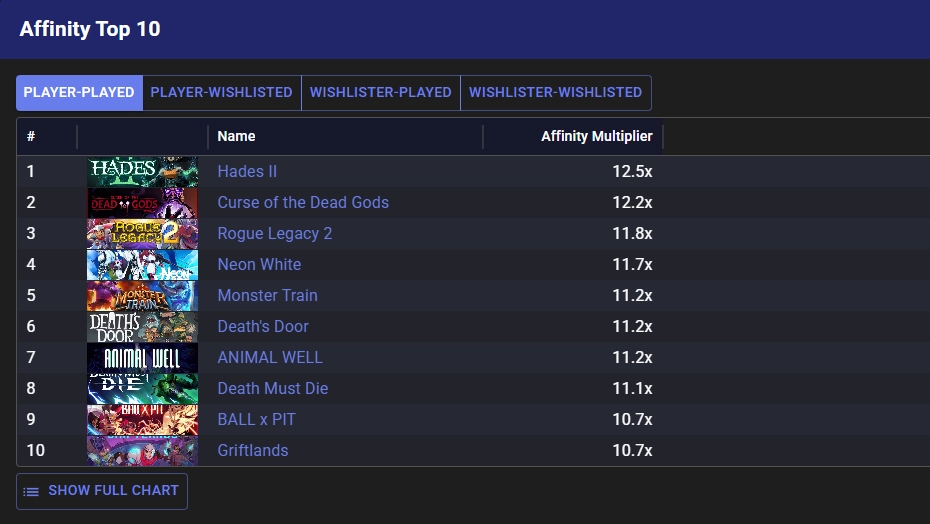
Step 3: Review Mining (Reading the Room)
Once you have identified 5 to 10 neighboring titles, it’s time to dig into their player reviews. This is where you uncover the unwritten rules of your genre.
Don't just look at the praise. The real gold is buried in the negative reviews of successful games.
Go to a highly successful game in your genre and filter by negative reviews. (You will have to filter out the fluff, like joke reviews, server downtime complaints, or localized language rants). Look for patterns in mechanical frustration:
- “Great game, but the endgame build variety is non-existent.”
- “I love the loop, but the inventory management feels like a chore.”
- “Fun for 5 hours, but the procedural generation feels incredibly repetitive.”
Every legitimate mechanical complaint in a competitor's negative review is an open invitation for your game's unique selling point. If every player hates the inventory management in Game A, and your game solves that problem natively, you have just found a core pillar of your pitch.
Step 4: The Feature Sheet
Genre Must-Haves vs. Your Unique Take
Before you start putting together a pitch (which we will break down in the next chapter), lock down your production schedule, or start grinding away inside the game engine, you need to know exactly which features are your non-negotiable baselines and which ones are your unique differentiators.
A massive trap for indie devs is simply not knowing what core players actually expect. Believe me, every genre has a set of foundational features that players consider mandatory. If you don't have them, they just won't play your game.
This isn't about telling you to make your game less unique. Innovation is great, but the baseline mechanics must be there to support your twists.
Here is an example of how you map your neighborhood using real-world market contenders as an example:
| Neighboring Game | Core Tags | Key Features (Genre Must-Haves) | Unique Selling Point |
| Game A | Bullet Heaven, Roguelite, Pixel Art | Weapon Evolutions & Gold Meta-Progression: Players demand a massive web of weapon combinations and permanent stat upgrades between runs to feel a sense of continuous growth. | One-handed, minimalist controls paired with a massive web of over 100+ cascading hidden achievements and item unlocks that trigger high player satisfaction for a very low entry price. |
| Game B | Action Roguelike, Bullet Heaven, Hack & Slash | Synergy Drafting & Distinct Classes: Players expect deep, RNG-based skill synergies (like active god blessings) and characters that play completely differently from one another. | Merges the nostalgic aesthetic and endless gear-grinding satisfaction of classic late-90s hack-and-slash games directly into a fast, modern 20-minute run format. |
| Game C | Action RPG, Bullet Heaven, Dark | Branching Talent Trees & Persistent Meta-Progression: Satisfies the deep build-crafting craving with visible, strategic skill paths and predictable boss wave triggers that test player builds. | Bridges the casual survivor loop with high-fidelity 3D graphics and heavy, visceral physics (ragdolls, knockback, and wall-smashing) that transforms a passive "dodge-only" genre into a tactical, high-impact combat experience. |
The Pitch & Reality Check
This section is where many developers fail before they even start. They approach a pitch like an art project, when it is actually a business proposal.
In this chapter of The Hard Way, we break down why a pitch deck isn't just about explaining your game, it’s about proving that you are a reliable partner who understands the market and product.
In today's market, a publisher isn't just buying an idea, they are investing in a team and a vision. You might have the best game loop in the world, but if your pitch doesn't show that you understand your audience, your budget, and your competition, it’s often an immediate "no."
The Death of the "Paper Pitch"
Let’s be real - Signing a project based only on a PDF is nearly impossible in 2026. Publishers need to feel the game. A prototype (or a "Vertical Slice") is now a requirement. It doesn't have to be polished, but it has to prove that your core loop is actually fun and that your team can execute the vision. If you don't have a prototype, you aren't pitching a game, you're pitching a dream and dreams are expensive.
The Anatomy of a High-Impact Pitch
Your pitch deck needs to be high-impact and lean, aim for roughly 10 to 12 slides. Before you hit send, do your recon: check the publisher’s website for specific submission portals or guidelines. Every publisher has a little bit different filter for what they value. For example, Raw Fury’s Developer Templates can be an incredible resource that can help you understand exactly how to structure your data for Raw Fury.
While requirements vary, a Hard Way pitch deck usually consists of these core pillars:
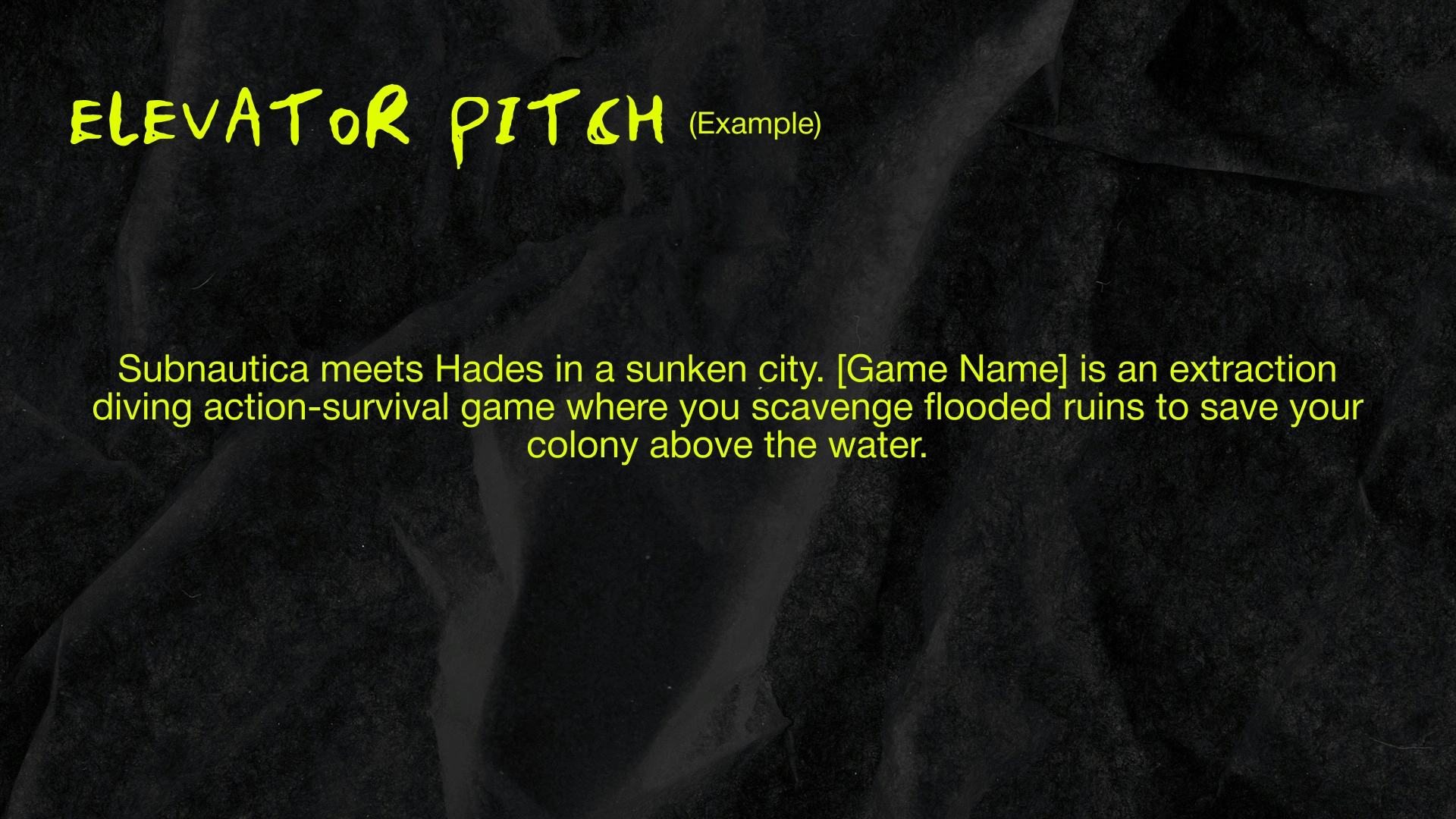
1. The Elevator Pitch
The Definition: A one to two sentence summary that explains exactly what the game is, the genre, and the hook.
- If you can't explain your game in the time it takes to ride an elevator, the concept is likely too muddy.
- Example: "Hades meets Pokémon - a fast-paced roguelite where you collect and evolve the bosses you defeat."
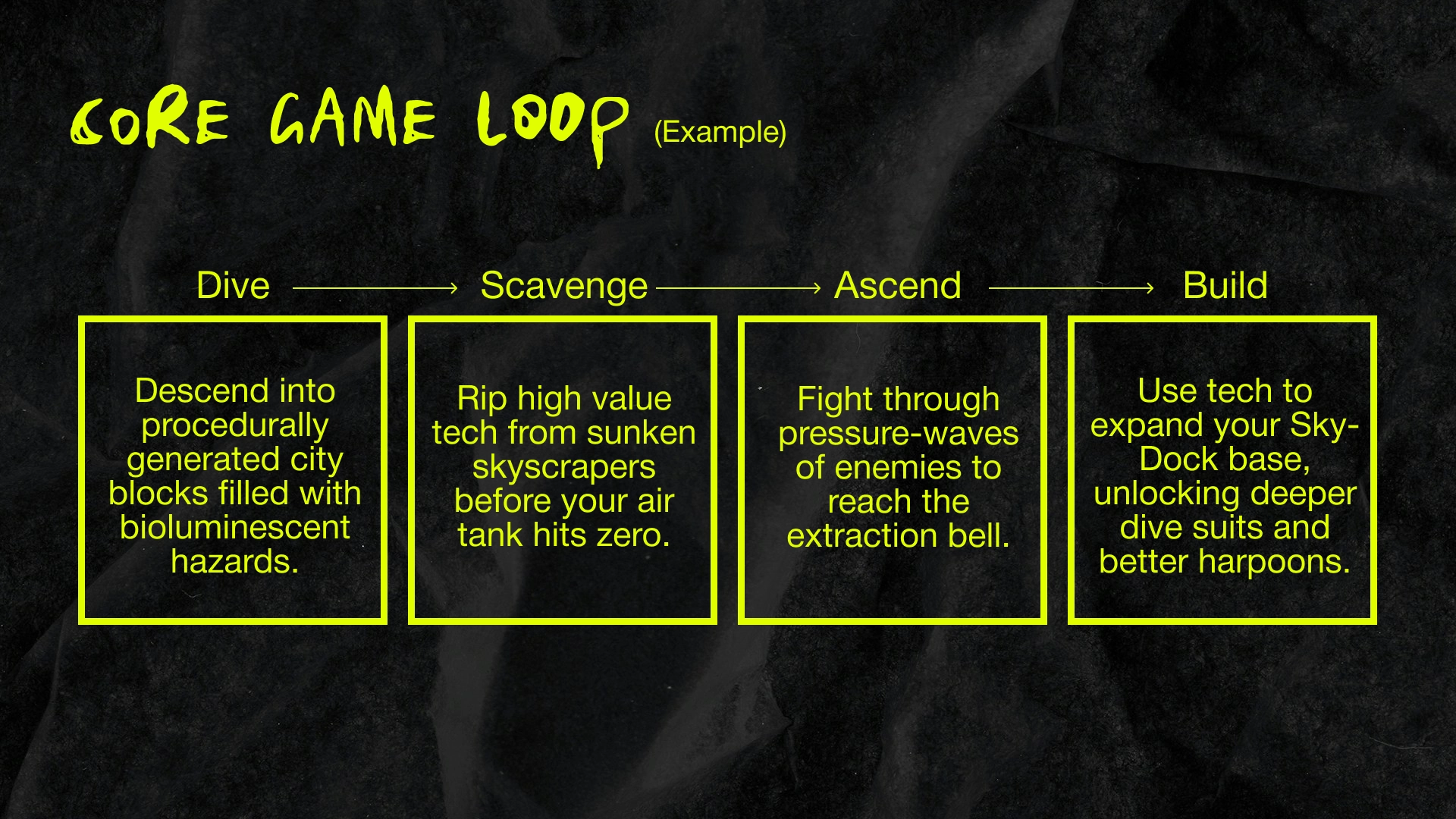
2. The Core Game Loop
The core loop is the "heartbeat" of your game. It is the fundamental cycle of actions that the player performs over and over again. If this engine isn't satisfying, no amount of story or graphics will save the project.
- The Definition: The repetitive cycle of gameplay (e.g., Explore → Combat → Loot → Upgrade → Repeat).
- The Engine of Fun: While the loop is repetitive by nature, it must be the primary source of fun. You need to explain not just what the player does, but why it feels good to do it. The loop should provide immediate satisfying feedback while simultaneously creating the desire to progress. Why does the player want to do it for the 100th time? Because each cycle offers a sense of mastery or a reward that feeds into the next, larger goal.
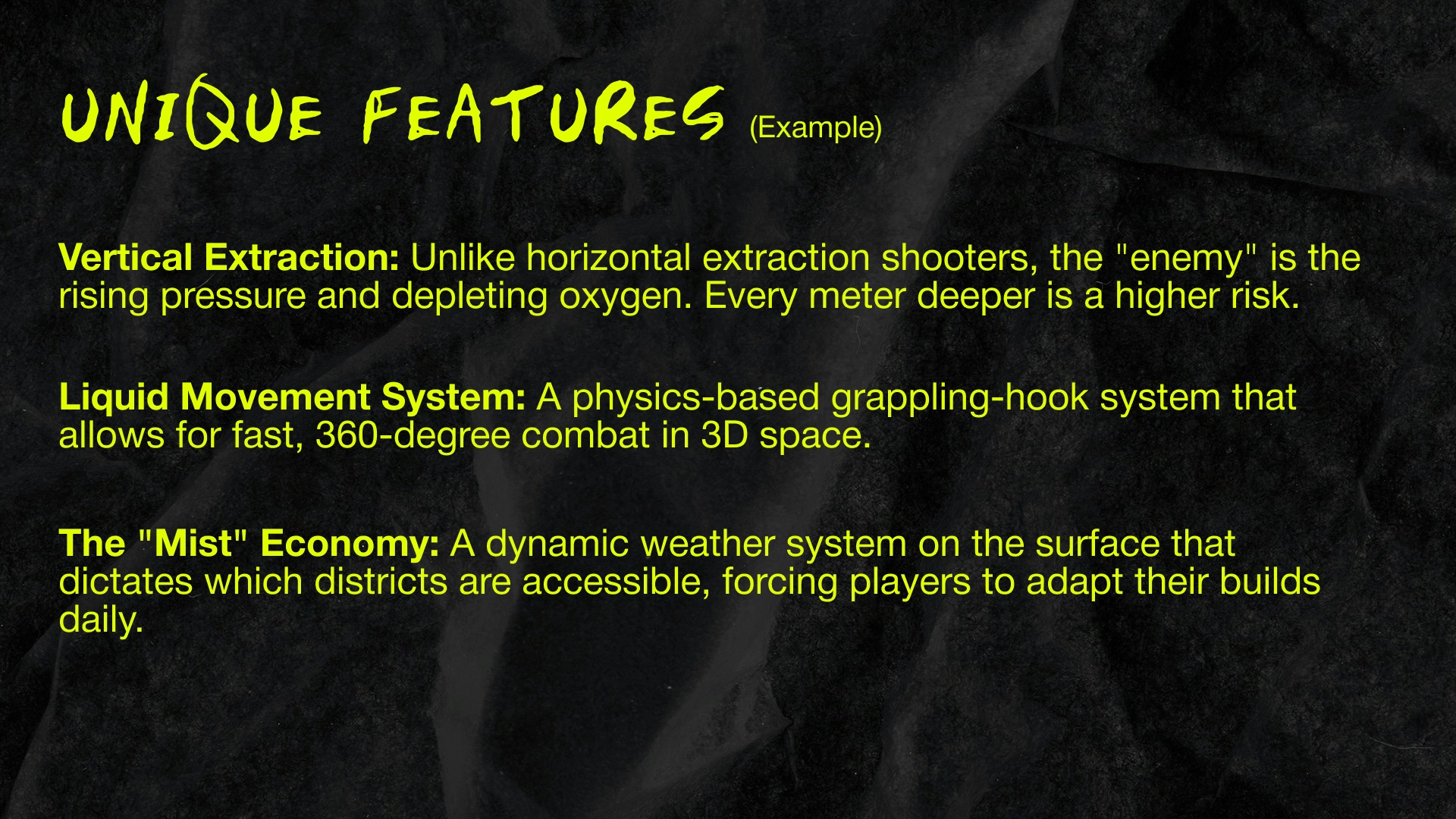
3. Key & Unique Features (USP)
It is vital to distinguish between what your game has and what makes your game special. You need both to convince a publisher.
- Key Features (The Experience): These are the high-value features that core players consider mandatory just to recognize your game's loop. Think deep skill trees, procedurally generated dungeons, or local co-op. While they aren't necessarily unique, leaving them out means genre fans will likely ignore your game or hit you with negative reviews at launch. Publishers look for these features in your pitch because it proves your genre literacy. It shows them that you aren't designing in a vacuum, that you actually understand what your target audience demands, and that you know how to give it to them.
- Unique Selling Points (The Innovation): This is your USP - the answer to why your game stands out among 50 others in the same genre. The Warning: Point and click, Great graphics, or Emotional story are not USP, those are technical descriptions or basic expectations. A true USP is for example a unique gravity-changing mechanic or a specific visual style that has never been applied to that genre.
Use your Key Features to prove your game is a solid entry in its genre, then identify your USP and hammer it home as the reason players will choose your game over the competition.
4. Visual Direction
Don't just tell us it looks "dark and moody." Show it. A publisher wants to see that the game has a distinct look that will stand out in a crowded Steam store.
- Not Just a Solo Slide: Visual direction shouldn't be a single page you click past and forget. Your entire deck should be an extension of the game itself. Use UI components, borders, and graphic elements directly from your project to frame every slide.
- Screenshots and GIFs: Sprinkle actual prototype screenshots, crisp GIFs, or short video loops throughout your presentation. By the time the reader is halfway through your deck, your visual identity should be so obvious that they don't even need to ask what the game looks like.
Pro-Tip: You don't have to use low quality GIFs. Use modern video formats like .webm instead. A free video converter like HandBrake is your best friend here - it will help you optimize your clips so they stay high-fidelity while keeping the file size incredibly small.
- Constant Reinforcement: When you show your mechanics or your team, use the game's font and color palette. This demonstrates that your visual direction is fully realized and consistently applied, making the project feel like a professional product rather than a collection of assets.
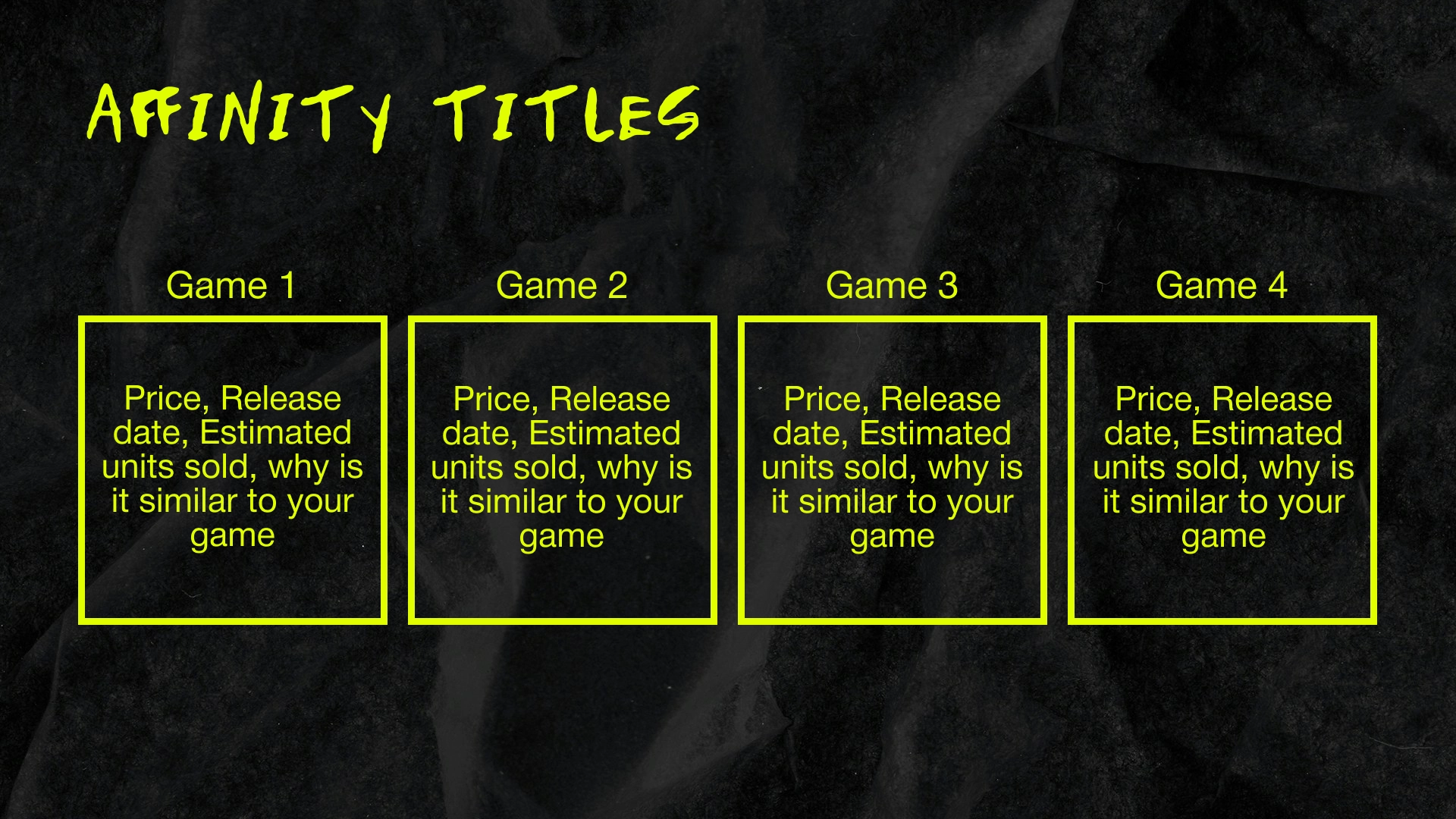
5. Affinity Titles & Market Research
When you pitch, remember that you aren't just selling a game, you are selling a market opportunity. Publishers need to see that you have vetted your own idea against reality. You do this by proving you know your neighbors - the games that live in the same neighborhood as yours.
Don't just list 3-5 "Comparable Titles" that you like, list games that your potential players are already playing.
- Avoid the Hit Trap: Do not only list mega-hits like Stardew Valley, Hades, or Elden Ring. These are outliers. If your only comps are billion dollar franchises, it looks like you don’t understand the mid-range market where most indies live.
- Focus on the Recent: Include games that launched in the last 24 months. This proves the market for your genre is active right now.
- Including the Numbers: If you choose to list estimated sales figures for your comparable titles (which is optional), ensure you use a mix of High Success and Mid-Range games. This data forms the base for your own sales projections and demonstrates that you understand both the realistic floor and the potential ceiling for your project. While every developer aims to be among the top performers, it is ultimately more important to show what your game has in common with these titles, in terms of mechanics and audience appeal, than it is to simply point at their revenue.
How to find the data: You can use tools like GameDiscoverCo (paid, but highly recommended for professional insights) or use the "Review Multiplier" method (e.g., Number of Reviews × 55).
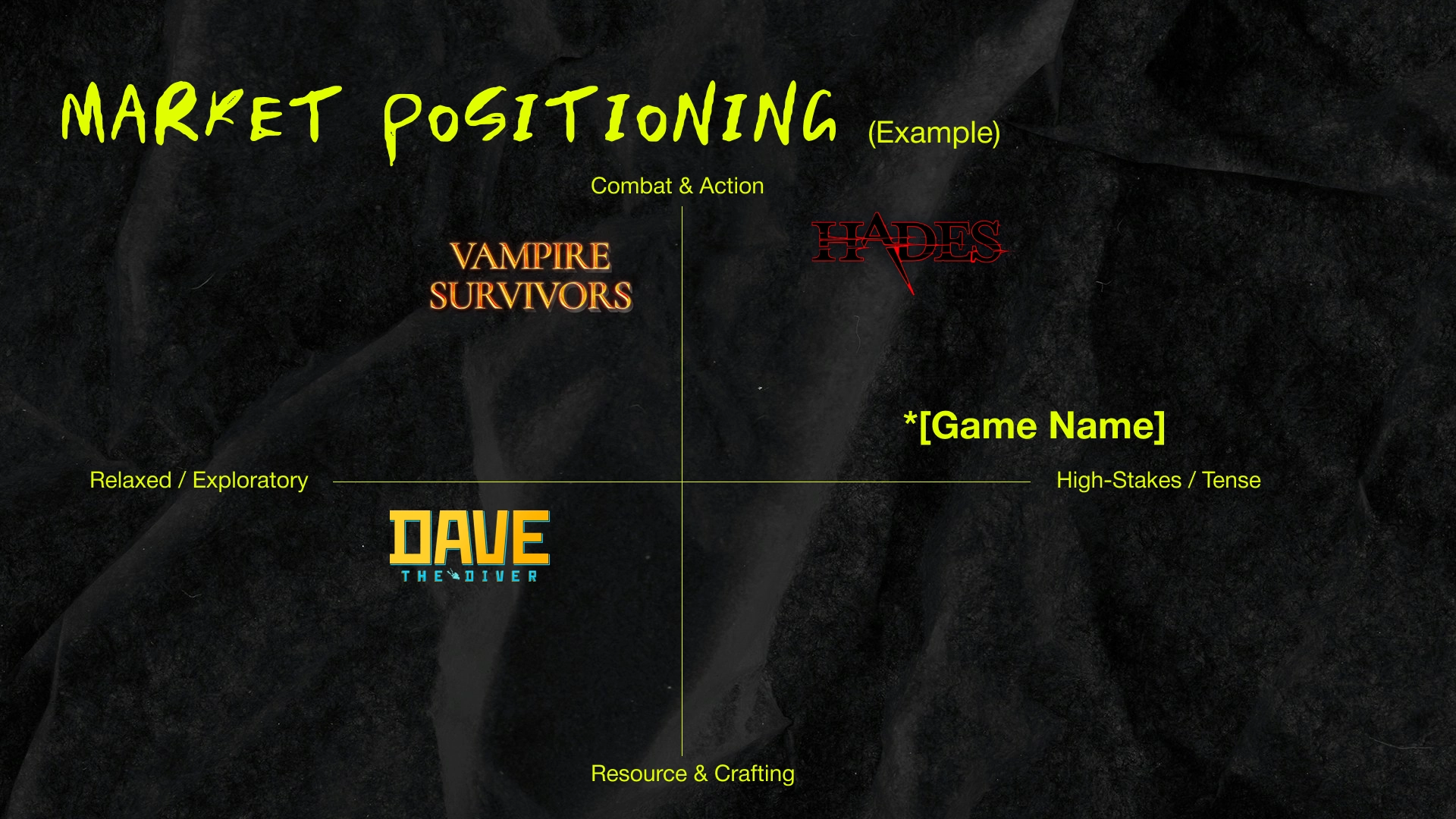
The Market Positioning Map
A visual graph is often the best way to show where your game sits. By plotting your title against your comps, you can show exactly which gap in the market you are filling.
- Choose Your Axes Wisely: Use meaningful, objective scales (e.g., Casual vs. Hardcore, Abstract vs. Realistic, or Narrative-Driven vs. Systems-Driven).
- The Warning: Be extremely careful when choosing these axes. If you use vague or subjective labels (like "Bad Graphics vs. Good Graphics" or "Boring vs. Fun"), you will invite unnecessary questions and look like an amateur. Your axes should clearly demonstrate why a player who is "here" on the graph would want to move "there" to play your game.
6. Timeline, Budget, Ask & Support Needed
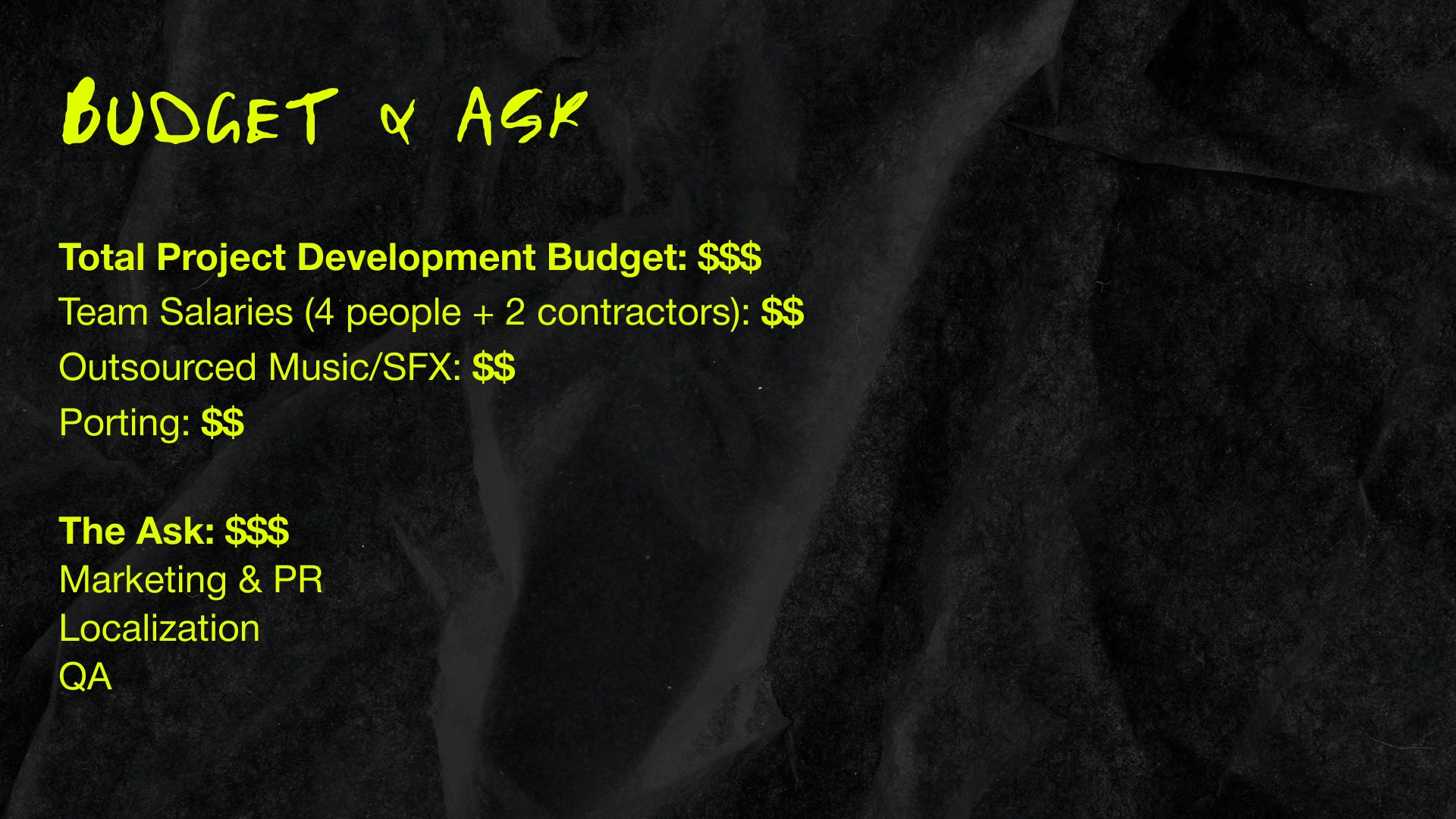
The Reality: Being reasonable is better than being cheap.
- Provide a clear roadmap (Prototype, Vertical Slice, Demo, Launch…) and a budget that reflects the reality of your team size and the genre's standards.
- Your budget needs to reflect the actual cost of running a professional studio, not just a hobby. This includes the business rate of your team’s salaries (base pay plus overhead like office space, taxes, and hardware), software licenses, and any outsourced services you don't have internally (like music or SFX). Always include a contingency buffer for the unexpected delays that happen in every project.
It is vital to distinguish the Budget from the Ask. While the budget is the total cost, the Ask is the specific amount of money you are requesting from this partner to make the project happen. If you’re asking for $5M but only have a team of two, what is that money actually for? Prepare a detailed breakdown of your costs, because you will definitely be asked to justify it. Being reasonable isn't about being cheap, it's about proving you know exactly how to manage a budget.
- A publisher needs to calculate their own internal costs to see if the deal makes sense for them. Be explicit about what services you expect them to provide beyond just the cash (Localization, QA, Marketing & PR etc…)

7. The Team
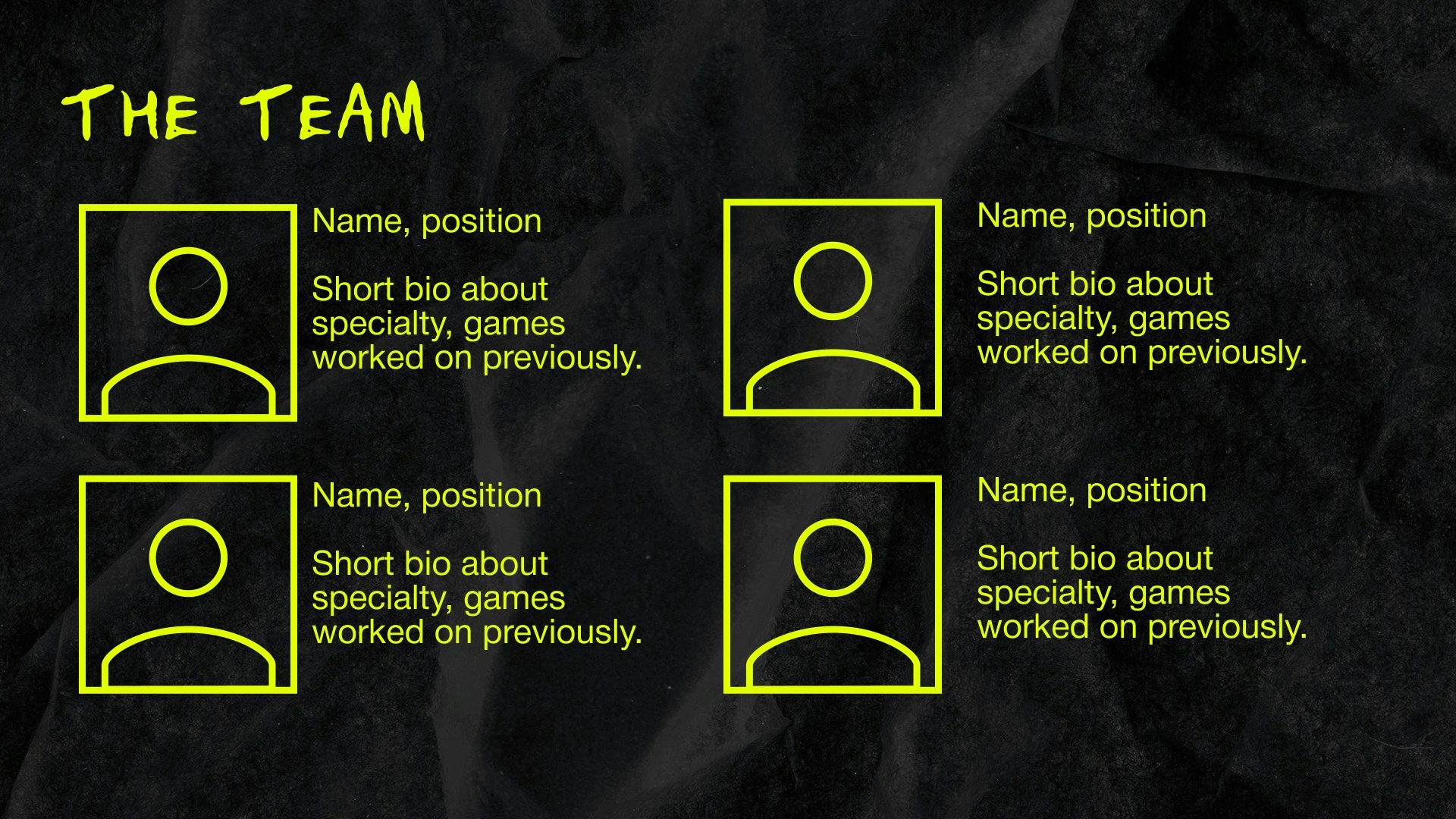
The "Team" slide is where you prove that your studio is a safe bet. Publishers like to see that your team has the specific skills required to build the exact game you are pitching.
- Tech Proficiency: Clearly state your experience with the technology you are using for the current project (UE, Unity, Godot). A team that has spent five years mastering a specific engine is a much lower risk than a team learning a new workflow on the fly.
- Shipped History: Highlight any games you have successfully shipped in the past. Even if they were smaller projects or in a different genre, shipping a game proves you know how to navigate the "final 10%" - the hardest part of development where most projects fail.
- Role Alignment: Briefly show who is handling the core pillars (Code, Art, Design). You want to show a balanced squad that isn't missing a critical piece of the puzzle.
- The Why Behind the Game: Don't just list your names and titles. Explain why you are the right team to make this specific game. Are you veterans of the genre? Is this a project born out of a decade of competitive play?
If you don't have a long list of shipped titles, focus heavily on your technical stability. Show that you’ve already solved the hardest technical hurdles of your game in the prototype. A publisher is much more likely to sign a "new" team if they can see that the team actually knows how to use their tools to deliver a polished experience.
Keep it Lean, but Deep Where it Counts
While the list above is your foundation, remember that a pitch is a living document. You can (and should) add more if your specific genre demands it. The goal is to stay short and cut out the fluff (like 10 pages of game lore that no one will read yet) and replace it with business intelligence.
For example, if you are pitching a multiplayer game, you can (and should) include a player retention plan and a long-term content strategy. A publisher’s biggest fear with multiplayer is a ghost town launch. You must show that you aren’t just planning for Day 1, but for Day 100 and beyond. If you don't show how you'll keep players coming back, the project looks like a short-term gamble rather than a sustainable business.
Quick Summary of the Pitch Checklist
- Elevator Pitch: The 2-sentence hook.
- Core Loop: What the player does every minute.
- Unique Features: What actually makes you different (not just "it's fun").
- Visual Direction: High-quality proof of the "look."
- Affinity Titles: Proof that an audience exists for this.
- Timeline, Budget & Ask: A realistic, business-rate breakdown and Ask
- The Team: Proof of technical capability and shipped history.
- Genre-Specific Depth: Retention plans (for multiplayer), narrative pillars (for RPGs), etc.
One Final Tip: End your pitch deck with "Where we are now & What we need." Don't make the publisher guess. Tell them exactly how much money you need, how much time is left, and what you’re looking for in a partner (Funding? Porting? Marketing?). Clarity is respect.
The Reality Check: Scope, Team, & The "GTA Trap"
One of the hardest lessons for new developers is that big scope does not equal big success. In fact, the larger your scope, the higher the risk and publishers are in the business of managing risk. If you are a team of two with no prior commercial releases pitching a $5M "open-world RPG with infinite possibilities," you aren't showing ambition, you're showing a lack of experience.
I call this the GTA Syndrome. I use that term because I have personally been pitched "the next GTA" by teams of two or three people few times. It is frankly terrifying to see developers with no prior experience asking for millions to build a massive open-world epic. It shows a fundamental misunderstanding of how games are made.
The "GTA" Syndrome
We see it all the time: a tiny team wanting to build the "next big AAA competitor." Here is why that pitch fails:
- The Math Doesn't Work: A $5M budget for a team of two implies a decade of development or a massive hiring spree you aren't prepared to manage.
- The Experience Gap: If you haven't shipped a small game, a publisher has no proof that you can ship a large one. Shipping a game, any game is a skill in itself.
- The Risk Profile: A publisher would rather spend $300k on a highly polished, unique "small" game than $5M on a "budget" version of a AAA title that will inevitably look and play worse than the competition.
If your pitch requires a "miracle" to succeed (like hiring 20 people overnight or inventing a brand-new technology), most publishers will pass. We look for achievable excellence, not impossible dreams.
The Power of the "Small" Idea
Some of the biggest unicorns in the industry, the games that generated millions of dollars and defined genres, started with a tiny scope and a single, brilliant hook.
Think about the games that have dominated Steam lately. Many of them didn't have 100 hours of unique content or 4K realistic graphics at launch. They had:
- A Tightly Defined Scope: They did one thing better than anyone else.
- A Strong Hook: You could understand why the game was fun just by looking at a 10-second GIF.
- Achievable Execution: The team was the right size for the task, meaning they could actually finish the game without burning out or running out of money.
Small games can be massive hits. Bloated games are usually just expensive failures.
Start Small to Build Big
The goal of your first game shouldn't be to build an empire, it should be to break the Circle of Death. Your first mission is simple: Finish a project. By finishing, you do three things that 90% of developers never achieve:
- Secure Cash Flow: You stop living pitch to pitch and start funding your own creative freedom.
- Build a Reputation: You prove to publishers, platforms, and players that you are a team that delivers. In this industry, "reliability" is a superpower.
- Gain the Momentum: Every small win adds to your studio’s "Experience Points." You learn how to handle the stress of launch, the technical debt of a live game, and the nuances of the market.
Once you’ve proven you can ship a small, successful game, the conversation changes. Getting $5M for your second or third project becomes infinitely easier because you are no longer a risk, you are a proven asset.
The Hard Way is learning that the fastest way to the top is by taking the stairs, not trying to jump to the roof. Build your foundation first, the empire will follow.
Money & Survival
When people talk about indie survival, they usually mean making enough money to pay for rent and coffee. But in The Hard Way, I look at money differently. Money isn't just a currency for bills, money is time.
Every Euro or Dollar in your bank account represents a few more minutes, hours, or days you can spend fixing a core mechanic, polishing a trailer, or pivoting your strategy. If you run out of money, you run out of time. And if you run out of time, the game and the studio dies.
The Lifetime Limit
There is a harsh reality most developers ignore when they are caught in the Circle of Death: Game development is slow.
A typical indie project takes anywhere from 1 to 4 years to go from concept to launch. If you start your career at 20 and retire at 60, and you spend an average of 4 years per project, you only have about 10 shots in your entire professional life.
When you think about it that way, every project becomes a massive portion of your life. You cannot afford to spend 4 years on a project that fails simply because you didn't understand your burn rate or because you signed a predatory contract that took all your cash flow. Strategic endurance is about making sure those 10 shots count.
What We’ll Cover
This chapter is designed to give you the financial and strategic armor you need to survive those 2-4 year cycles without burning out or going bust.
- The Anatomy of an Indie Budget: Why "business rate" salaries and overhead are non-negotiable, and how to account for the "invisible" costs of launch.
- Runway & Burn Rate: How to calculate exactly when the lights go out, and why a "contingency buffer" is your most important asset.
- Investors vs. Publishers: Who should you take money from? We’ll break down the pros, cons, and "strings attached" for each.
- The Art of the Deal: How to protect your future. We’ll look at recoupment math, milestone discipline, and how to keep your IP.
- Finding the Capital: Practical advice on where investors and publishers hide (and how to use tools like LinkedIn and MeetToMatch to find them).
1. The Anatomy of an Indie Budget
Most first-time developers create a wishlist and call it a budget. We don't do that. A budget is a professional business document that accounts for the cold, hard reality of keeping a team alive and a project moving.
If your budget is too low, you’ll run out of money at the 90% mark (the hardest part). If it’s poorly researched, a publisher will see it as a red flag that you aren't ready to manage a professional studio.
1.1 The "Business Rate" of Salaries
The biggest mistake indies make is budgeting for survival (rent and food). You should be budgeting for Business-Rate Salaries.
- Base Salary + Overhead: A developer's cost to the studio is their salary PLUS taxes, insurance, social contributions, and benefits. Depending on your country, the overhead can add 20-40% on top of the take-home pay.
- Hardware & Software: Computers break. Licenses (Unity/Unreal, Creative Cloud, IDEs) expire. You need a line item for the tools of the trade.
- Office Space (or Remote Infrastructure): Even if you are remote, you have costs for Slack, Notion or cloud storage.
1.2 The Invisible Costs of Launch
If you are working with a publisher, many of these costs are usually borne by them as part of the deal. However, if you are going solo, these will come directly out of your pocket. You must account for them:
- Localization: Translating a game isn't just a luxury, it's a serious multiplier for sales in regions like France, Germany, China, Brazil and others..
- QA (Quality Assurance): You cannot test your own game effectively. You need professional eyes to find the edge case bugs that will tank your Steam reviews on Day 1.
- Music & SFX: Unless you have a full-time audio person, you will need to outsource this. High-quality audio is often the difference between a "cheap" feeling game and a "premium" one.
1.3 The Marketing War-chest: Visibility is Not Optional
In a market where dozens of games launch every day, visibility is your lifeblood. If you are working with a publisher, they usually bear the burden of marketing costs. But if you are self-publishing, you must not only budget for it, you must work on it from day one.
The biggest mistake a developer can make is ignoring marketing during development, only to scramble for a marketing agency or a publisher after a bad release. By then, it’s often too late.
I. The Trailer: Your First Impression
Your trailer is the very first touchpoint players have with your game. Before they read a single line of text, they will watch your video.
- The Goal: To make them say, "I want to play that."
- The Budget: If you aren't a video editor, budget for someone who is. High quality screenshots and a punchy, well-paced trailer are the primary tools that convert browsers into wishlists. You don't need a super expensive film editor. What matters most is that the creator of the trailer understands the game. They need to know exactly which mechanics to showcase, how to highlight the hook, and how to communicate the vibe of the game within the first 10 seconds.
II. Ads, Influencers, and Media
While we will dive deeper into this in the Marketing & Visibility chapter, your budget must account for the "fuel" that drives traffic:
- The Low-Budget Win: You can achieve massive results with a very small, targeted budget for ads or influencer outreach tools, provided you have a strong "hook."
- Media Outreach: Even small costs for press release distribution or event submissions need to be tracked.
III. Publishing as a Service (PaaS)
If you want to stay independent but realize you aren't a marketing expert, you can hire "Publishing as a Service.
Revenue Share: You hire a team to handle the marketing and they take a percentage of the sales. This is often the better option because their "skin in the game" means they are incentivized to make the game a hit.
Flat Fee: You pay a fixed price for specific services. This is cleaner but means the service provider gets paid regardless of how well the game actually performs.
Marketing is not something you "add" to a game at the end. It is part of the development process. If you wait until launch to care about your audience, you've already failed. Whether you do it yourself, hire a service, or sign with a publisher, someone must be fighting for the game's visibility from the moment the first prototype is playable.
1.4 The "F-Up" Buffer
This is your safety net for the unknown during development.
- The Rule of Thumb: Always add a 20% buffer to your total development cost.
- Why? Because a Gold build rejection by a platform holder, a critical bug found two weeks before launch, or a lead developer getting sick can tank a project that has no cash reserve. Without this buffer, you are one bad week away from bankruptcy.
1.5 The First Month of Life
The most dangerous thing you can do is spend your last Euro on launch day. When the game hits thousands of players, they will find bugs that your QA team didn't.
- Critical Bug Fixing: You must have the budget to keep the team working at 120% for at least 30 to 60 days after release. Quick hotfixes in the first 48 hours are what save your Steam review score from "Mixed" to "Positive."
- Player Feedback & Tuning: Beyond bugs, you’ll need to adjust balance or difficulty based on real player data. If you can't afford to listen and react to your community in those first few weeks, they will leave and never come back.
If you are working with a publisher, they often expect at least some brief Post-Launch Plan as part of the contract. They want to see that you aren't planning to vanish the moment the game goes live. If you are self-publishing, this is even more critical, your reputation for your next project is built on how well you support your current one.
Remember that publishers and investors aren't looking for the lowest price, they are looking for the correct price. A budget that is too low tells them you don't know what you’re doing. A budget that is realistic even if it's higher tells them you are a professional who plans for success.
2. Runway & Burn Rate: The Math of Survival
In the industry, we often talk about games as passion projects, but the reality is that your studio is an engine that consumes fuel. Burn Rate is how fast you’re burning that fuel, and Runway is how much track you have left before the engine shuts off. If you don't know these two numbers to the penny, you aren't managing a studio, you're just hoping for a miracle.
I. Understanding Your Burn Rate
Your Burn Rate is the total amount of money leaving your bank account every single month. This must be an honest number.
- Fixed Burn: Salaries, rent, software subscriptions, accounting fees.
- Variable Burn: Freelance costs (music/SFX), marketing assets, or travel for events.
- The Trap: Many developers only calculate their "rent and food" costs. Your True Burn includes the business-rate taxes and overhead we already discussed in the Budget part.
II. Calculating Your Runway
Your Runway is the number of months you have until your bank account hits zero. The Formula is simple:
Current Cash / Monthly Burn Rate = Months of Life Remaining
If your runway is 6 months, and your game is 8 months from completion, you are already bankrupt, you just haven't stopped moving yet. You need to act now, not in 5 months.
The "Safety Zone" Strategy
You should never let your runway drop to zero before a game launches. You need to manage your money so you have a Safe Exit.
| Runway Remaining | Status | Action Required |
| 12+ Months | Stable | Focus 100% on development and quality. |
| 6-9 Months | Warning | Start pitching to publishers or looking for bridge funding immediately. |
| 3 Months | Critical | You are in the Danger Zone. You may need to cut scope, look for emergency loans, or prepare for a launch. |
Breaking the "Circle of Death" with Math
To break the cycle of pitching just to survive, you need to calculate your Minimum Viable Success (MVS).
Before you launch, you should know exactly how many copies you need to sell to:
- Pay back your publisher (if you have one).
- Cover your development costs.
- Fund your next 6 months of "Runway" so you can start the next project without a desperate pitch.
If your game needs to sell 500,000 copies just to break even, your scope is likely too big for your genre. The Hard Way is realizing your math is wrong after you’ve spent three years on the project.
The Sales Funnel (The Multipliers)
If you have 10,000 wishlists at launch, here is what the "median" success looks like in 2025/2026:
- Week 1 Sales:
Wishlists x 0.2(Example: 2,000 copies). - Day 1 Sales:
25% of Week 1 Sales(The initial "Spike"). - Year 1 Revenue:
Week 1 Revenue x 3(The "Long Tail" of sales and seasonal discounts). - Year 3 Revenue:
Week 1 Revenue x 5.5(The "Evergreen" phase).
2. The Multi-Platform Multiplier (Sim-Shipping)
If you launch on Consoles (Xbox, PlayStation, Switch) at the same time as Steam:
- Console Revenue: Roughly 45% of your Year 1 Steam Revenue.
If your Steam Year 1 revenue is €100k, you can reasonably forecast an additional €45k from consoles.
The "Net" Reality Check - The 58% Rule
When you see a game gross €1,000,000 on Steam, it’s easy to think the developer is a millionaire. In The Hard Way, we look at the bank statement, not the Steam dashboard.
After you account for the platform cut, global taxes, and the inevitable demo-mode of modern players (refunds), your take-home pay is significantly lower than you think.
As a general rule of thumb for a professional indie studio, you should expect to keep roughly 58% of your gross revenue. Here is where the other 42% goes before it even reaches your company bank account:
- Platform Cut (-30%): Steam and Consoles take their standard "tax" for providing the storefront.
- VAT & Sales Tax (-10% to -12%): Steam collects this globally. While it varies by country (0% in some US states, 25% in parts of Europe), the global "blended" average usually eats about 11% of your gross.
- Returns & Chargebacks (-5% to -8%): This is the cost of doing business. If your game is buggy or "not for them," players will refund it within the 2-hour window.
The Reality Formula
Gross Sales (€) × 0.58 = Your Actual Revenue.
If your game sells for €20.00, you are actually receiving €11.60.
How to use this for your Studio
To see if your project is "Safe," run this calculation backwards:
- Determine your "Survive & Pivot" cost: How much do you need to pay the team for 6 months after launch plus the cost of starting the next prototype? (e.g., €150,000).
- Calculate the Sales Target: How many copies do you need to sell to reach that Net total?
- Check your Wishlists: If you need to sell 20,000 copies in Week 1 to survive, but you only have 5,000 wishlists, you are in the danger zone.
If your math shows you won't hit your survival target, you have two choices: increase your marketing (to get more wishlists) or drastically cut your scope (to lower your burn rate). Hoping the multipliers will "magically" be better for you than the median is how studios die.
Funding Your Project: Publisher vs. Investor
The real difference between these two isn't just "who gives the money," but who does the work.
The Publisher: "The Marketing & PR Engine"
A publisher is a service provider who funds development. They are experts in Visibility.
- The Deal: They provide the cash, but more importantly, they provide the Labor. They handle the trailers, the press outreach, the influencer keys, the Steam festivals, and usually also the localization and QA.
- Skin in the Game: A good publisher is motivated because they only get paid if the game sells.
- Publishing as a Service (PaaS): If you don't need development funding but you do need professional marketing, look for Publishing as a Service (ideally for revenue share). Instead of a full-blown "we own the rights" deal, you hire an agency to act as your publisher. They take a smaller revenue share than a traditional publisher, but they still have skin in the game. If the game fails, they don't get paid. This aligns their incentives with your success.
The Investor: "The Bank"
An investor (Angel or VC) is usually just a source of Capital.
- The Deal: They give you the money, but all the work stays with you. You are still responsible for finding a marketing agency, managing your own PR, and fighting for Steam visibility.
- Project Investment (The "One Game" Deal): This is where an investor funds a specific project in exchange for a share of that game's profits. For a first-time team, this is the most realistic path. You are selling a "cool idea" and your ability to execute it, rather than the value of a company that doesn't have a track record yet.
- Equity Investment (The "Piece of the Company" Deal): This involves selling shares of your studio. While attractive, it’s much harder to pull off early on. When you're just starting, your company doesn't have much intellectual property (IP) or market value. Most equity investors wait until you’ve proven you can ship a hit before they buy into the empire.
- Why choose them? If you already have a world-class marketing person on your team and just need the cash to keep them paid, an investor might be cleaner than a publisher.
The 100% Recoupment Trap
Most publishers or investors will want to take 100% of the game’s revenue until their initial investment is repaid. This can leave your studio with zero cash flow for months after launch, even if the game is selling relatively well.
Using your Prototype or Vertical Slice as Leverage
If you approach a publisher with just an idea, you have no leverage. But if you show up with a polished Vertical Slice (a playable 15-minute chunk of the game that looks and feels final), you have already proven the project's viability.
- The Argument: "We have already invested 6 months of our own time and money to get to this quality. Because we have lowered your risk, we want a Revenue share from day one."
- The "Hybrid" Split: Even if you can't get a full split, fight for a "75/25" or "80/20" split during the recoupment period. This ensures your studio has enough cash to keep the lights on and fix bugs while the publisher gets their money back.
Where to Find the Money: The Hunt
Starting is hard, but finding the right partners isn’t impossible if you do your homework. In the Hard Way, we don't spam every email address we find, we target with precision.
1. Know Your Neighbors
The most important step is identifying who actually cares about your genre. You need a list of potential partners who have a track record of success with games similar to yours.
- Filter the Field: Use tools like Gamalytic to filter through the "Indie" and "AA" publisher space. Look for publishers who have released games in your genre that hit decent sales numbers.
- The "Affinity" List: Go to Steam, find games that feel like "neighbors" to yours, and click on the publisher link. If they have published 10 deckbuilders and your game is a deckbuilder, they are your target.
2. Choosing Your Battles (Events vs. Remote)
Traveling to massive events like GDC (San Francisco) or Gamescom (Cologne) is incredibly expensive. For an indie on a tight budget, this can eat weeks or even months of your runway.
- The Leap of Faith: Only go to these big events if you can pack your schedule. If you have 10+ meetings confirmed with high quality publishers or investors, the cost of the flight and hotel becomes an investment. If you’re just going to walk the floor and hope to meet someone, stay home and keep developing.
- The Local Alternative: Look for smaller, regional events (like Nordic Game, Reboot Develop, or Digital Dragons). They are cheaper, less crowded, and often have a higher ratio of scouts to developers.
I. The LinkedIn "Deep Scout" Strategy
Scouts are the "gatekeepers" of the industry. Their job is to filter thousands of projects to find the three that fit their portfolio.
- Target the Right Role: Look for "Game Scouts," "BizDev Managers," or "Portolio Managers." Avoid messaging the CEO or the lead developers—they are too busy with internal operations.
- The "Warm" Connection: Before you pitch, engage with their content. If they post an article about a trend in your genre, leave a thoughtful comment. It makes your name familiar before your pitch hits their inbox.
- The Direct Message (DM): If you use LinkedIn Premium, use your InMails sparingly. A short, respectful note showing you know their catalog is more effective than a wall of text.
II. MeetToMatch: Navigating the Noise
MeetToMatch is the industry standard for event-based networking, but as the scene has grown, it has become cluttered. You need a filter to make it worth the cost of the ticket.
- Filter the Service Noise: You will be flooded with requests from localization studios, music composers, and porting houses. While these are useful later, they can distract you from your goal. Use the search filters to focus strictly on Investors and Publishers.
- Request Early: The calendars of top-tier scouts (like those from Devolver, Team17, or Raw Fury) fill up 3 to 4 weeks before an event. If you wait until the last week before event, their schedule will already be locked.
- The Buffer Rule: Never book meetings back to back without at least a 10-minute gap. Events like Gamescom are massive, and you will likely spend 15 minutes just walking from one hall to another.
III. Pitching Sessions: The "Speed Dating" of Gamedev
At many events, you’ll find formal Pitching Sessions or Big Indie Pitches. These are high-pressure, but high-reward environments.
- The 3-Minute Rule: You often only get 3 to 5 minutes to present. You cannot explain your lore. You must explain your Hook, show Gameplay, and state your Ask (how much money you need).
- The "Elevator" Mentality: Be prepared to pitch anywhere—in the coffee line, at the bar, or in the hallway. Have your 30-second "Elevator Pitch" memorized and a link/video ready on your phone or tablet.
- The Feedback Loop: Even if a scout says "no," always ask why. That feedback is often more valuable than the money, as it tells you exactly what the market is afraid of regarding your project.
The Art of the Follow-Up: Staying Memorable in the Noise
The most common way a potential deal dies isn't a “No” - it’s silence. Scouts and investors are juggling hundreds of pitches at once. However, you need to be strategic about when and how you resurface.
If you just met a scout at a major event like Gamescom or GDC, remember that every other dev is also following up within 48 hours. Their inbox is currently a graveyard of generic "Great to meet you" emails.
- Sometimes it is wiser to wait 3-4 days after an event has ended. Let the scout get back to their office, clear out the urgent internal emails, and actually have the mental bandwidth to look at your build.
- Your subject line should remind them exactly who you are.
- Bad: "Follow up from Gamescom."
- Good: "Follow up: [Game Name] - The one with the [Unique Hook/Funny moment from the meeting]."
- If you took a "selfie" with them or have a photo of them playing the game at your booth, attach it. It instantly triggers their memory of the human connection you made.
The "Update" Cadence
If they say, "It looks interesting, keep us updated," they aren't just being polite, they are waiting for you to prove you can hit milestones.
- Monthly Check-ins: Every 4–6 weeks, send a short update. "Hi [Name], just wanted to show you the new [Boss Fight/Mechanic] we just finished. We’ve also grown our wishlists to [Number]."
- The "Big News" Trigger: Always follow up if you hit a major milestone, like winning an award, getting a massive trailer view count, or reaching 10,000+ wishlists.
Handling the "No"
A "No" today is not a "No" forever.
- If they pass on the project, thank them for their time and ask: "Is there anything specific about the project that didn't fit your current slate?"
- Use their feedback to sharpen your pitch for the next person. If three publishers in a row say your "Art style is too dark for the genre," you have a data point you can act on.
The Engine of Success
If development is the act of building an engine, marketing is the act of finding the fuel and the road. You can build the most powerful engine in the world, but if it’s sitting in a dark garage where no one can see it, you aren't going anywhere.
In The Hard Way, we treat marketing not as post-development noise, but as a core technical requirement. It is more than just publishing a Steam page and posting on socials. Marketing is the process of creating Visibility, which generates Wishlists, which convert into Sales.
No Shortcuts, Just Strategy
We’ve all seen the viral lottery winners - the games that post one TikTok and wake up to 50,000 wishlists. That is luck, and you cannot build a business on luck**.** The reality for most successful indies is a grind of building a community, refining trailers, testing ad performance, and meticulously planning beats. It is a ton of work, but it is work that has a predictable outcome if you follow the math.
The PC First Focus
While consoles can be a significant part of your long-term revenue, for an indie developer, Steam is the battlefield**.** Steam’s algorithm is a meritocracy - it rewards games that show momentum. If you win on Steam, the consoles will follow. If you fail on Steam, the consoles rarely save you.
What we will cover in this chapter:
- The Foundation & Visual Hook: Optimizing your Steam page as a Conversion Machine. From Capsule Art and Tags to Trailers or Screenshots.
- The Wishlist Roadmap: Your Strategic Launch Timeline (Announcement to Release).
- The Influencer Game: Finding and pitching to the creators who move the needle.
- Organic & Paid Socials: The Visibility Engine
- Steam Next Fest Mastery: How to treat the festival like a Mini-Launch.
- Community Building: Turning followers into a team.
1. The Foundation: Steam Page Optimization
Your Steam page is not just a profile. It is a Conversion Machine. Most developers treat it as a task to check off, but in The Hard Way, we treat it as a product that needs its own Beta testing and polish.
If your marketing brings 10,000 people to your page but your optimization is poor, you might only get 100 wishlists. If its optimized, you might get 1,500. That difference is what determines if you survive.
1.1 The Capsule: Your Tiny Billboard
In The Hard Way, we don't just call it art. We call it The Hook. Your Key Art is the visual soul of your project. It’s on your social headers, your Discord banners, and most importantly it is the face of your game on the storefront. Whether you call it a "Main Header" or a "Small Capsule," this image is the single biggest factor in whether a player clicks your game or scrolls past it.
The Capsule is Not a Poster
A common mistake is taking a beautiful, high-detail vertical poster and "squashing" it into a Steam capsule.
- The Scaling Problem: Key Art designed for a website or a physical poster often fails as a capsule. Why? Because capsules are tiny.
- The "Clutter" Killer: If your art has too much going on - ten characters, a detailed background, and a complex logo, it becomes a brown smudge when viewed on a handheld Steam Deck or a small search result.
- The Rule of One: Focus on one strong character, one clear environment, or one striking motive. Simplicity scales, complexity blurs.
Design for the "Storefront Jungle"
Each capsule size serves a specific tactical purpose. You can't just "crop and pray."
- Header Capsule: This is at the top of your page. It needs to establish the "Vibe."
- Small Capsule: This is your Billboard. It’s what people see in Similar Games or Discovery Queues. It needs to be high-contrast and instantly readable.
- Consistency is Professionalism: Use the same font, color palette, and character art across all sizes. If the Small Capsule looks like a horror game but the Header looks like a cozy farmer, you’ve confused the player. A confused player never wishlists.
Communicating the "Vibe" and "Verb"
Your capsule must answer two questions in half a second:
- What is the genre? (The Vibe)
- What do I do in this game? (The Verb)
If you have a fast-paced shooter, your art should feel kinetic and sharp. If you have a slow, contemplative narrative game, use softer lighting and evocative character poses. If the player can't tell what your game is about just by looking at the art, you have failed the first test of marketing.
Weaponize Genre Research
Don't guess what works - scout the neighborhood. Identify the Trends: Go to your genre's tag on Steam (e.g. Metroidvania or City Builder). Look at the top 20 best sellers.
- Do they all use a specific color? (e.g., many Horror games use red/black/white).
- Where is the logo placed? Are they using character art or environmental art?
You want to look like you belong in the genre so players know what to expect, but you need some disruptive element (a unique color or a striking silhouette) so you don't disappear into the crowd.
1.2 Tags: Borrowing from the Neighbours
In the Steamworks backend, you can select up to 20 tags. While it seems like a lot, the priority is strictly top-down. Steam uses these tags to populate the "More Like This" section on other games' pages and to decide who to show your game to in the Discovery Queue.
The Hierarchy of Five
The first five tags are the most critical. They define your game's DNA in the algorithm. Many indies put "Indie," "Singleplayer," or "Action" in their top 5. Don't do this. Those are too broad. They put you in a pool with 30,000 other games. Use your Sub-Genre and your Core Mechanics.
The "Neighbours" Deep Dive
Don't just look at your neighbors tags - look at the order of them. Use Gamalytic or SteamDB to see which tags are driving the most traffic to successful games in your niche. If your game has 15 out of 20 tags in common with a massive hit like Hades, Steam’s algorithm will eventually start suggesting your game to Hades players. This is how you "hijack" the traffic of successful titles.
Before you even touch the tags on your own Steam page, create a simple sheet listing the tags of your neighbors and highlight yours. This lets you visually map out exactly where your game will be based in the Steam ecosystem before you lock anything in.
| Game A | Game B | Game C |
| 2D | Crafting | 3D |
| Action | Underground | |
| Adventure | Mystery | |
| Atmospheric | Underground | First-Person |
| Combat | Simulation | |
| Mystery | Crafting | |
| Exploration ✅ | First-Person | Singleplayer ✅ |
| Physics | Casual | Atmospheric |
| Pixel Graphics | Indie | |
| Post-apocalyptic | Tower Defense | Mining |
| Procedural Generation | Singleplayer ✅ | Physics |
| Adventure | Simulation | |
| Resource Management | Exploration ✅ | Procedural Generation |
| Roguelike | Sandbox | Sandbox |
| Sci-fi | ||
| Singleplayer ✅ | Mining | Exploration ✅ |
| Aliens | Adventure | |
| Economy | Economy | |
| Tower Defense | Post-apocalyptic | Casual |
Specificity = Conversion
Generic tags attract browsers, specific tags attract buyers.
Avoid prioritizing tags like Action, Adventure, 2D, Indie (These are "trash tags" for the algorithm, they provide no specific data). Don't forget themes. If your game is a "Cozy" game, that tag is more valuable than "Simulation" because it targets a specific psychological mood of the player.
The Community "Tag Attack"
Once your page is live, users can add tags. Sometimes they add joke tags or incorrect ones (like tagging a horror game as "Cozy").
Monitor your tags monthly. If incorrect tags become popular, it will confuse the algorithm and kill your organic traffic.
Actionable Step: Use your Discord community. When you first launch your page, ask your core fans to go to the Steam page and upvote the most accurate tags. This locks in the correct metadata early.
Tags are not a "set and forget" feature. Every few months, check the "More Like This" section at the bottom of your own Steam page. If the games listed there look nothing like yours, your tags are wrong. Change them immediately to better reflect your true neighbours.
1.3 Short Description: The Player’s Elevator Pitch
This is the 2-3 sentences located at the top right of your page. It shouldn't be a dry summary. it should be an invitation to excitement. By the time a player’s eyes move from your trailer to this text, they are asking one question: Is this for me? Your job is to answer with a resounding YES.
Your internal elevator pitch is for investors and partners, your Steam short description is for Players. You must shift from technical jargon to Emotional Verbs.
- The Technical Trap): "A procedural rogue-lite featuring physics-based combat, destructible environments, and a deep skill tree with over 50 unlockable abilities."
- The Problem: This is a list of features. It’s dry. It doesn't tell the player how they will feel.
- The Emotional Hook :"Shatter your enemies and the environment itself in this high-octane physics sandbox. Outsmart the chaos as you combine devastating spells to survive a world that collapses under your every move."
Focus on "The Doing"
Players don't buy systems, they buy experiences. Use your 300 characters to tell them exactly what the primary gameplay loop feels like.
- If the fun of your game is discovery, use words like Unearth, Reveal, Explore. If the fun is power, use Conquer, Dominate, Obliterate.
- If your game has a unique gimmick (e.g., you can only move when you shoot), that must be in the short description. It’s the reason they will click Wishlist instead of just looking at the next game.
The "Above the Fold" Rule
On many screens, only the first two sentences are visible without scrolling.
The Punchline First: Don't start with "In a world where..." or 1000 years of lore. Nobody cares about your story yet.
Lead with the Verb: Start with the gameplay.
- Example: "Build, defend, and expand your steampunk empire..."
- Example: "Hunt colossal beasts in a world where your only weapon is a grappling hook..."
1.4 The Visual Hook: Trailers That Convert
In The Hard Way, we don't make movies. We make trailers that sell. A player’s attention span on Steam is measured in milliseconds. If your trailer starts with a 5-second slow-burn logo animation, you have already lost 50% of your audience.
The goal of your trailer is to make the player say, "I want to try that right now."
The "Cold Open" Strategy
While the golden rule is "Show Gameplay Immediately," a powerful way to do this is through a Cold Open. This is a narrative technique that drops the viewer into the heat of the action or story from the very first shot - no logos, no credits, just immersion.
- Skip the Logos: Start with your most impactful gameplay. No "Produced by," no logos, no black screens.
- Establish the Tone: In the first 5 seconds, the player should know exactly what kind of game this is.
- The "Ready or Not" Example: Look at how Ready or Not uses this. It doesn't tell you it's a tactical shooter, it shows you a chaotic, high-stakes breach with players shouting. Within seconds, you understand the tension, the stakes, and the atmosphere. [00:02]
Show the "Human" Fun
You need to show the player the joy of playing. "Fun" is hard to describe in text, but easy to recognize in motion. For example if your game is a Co-op or Multiplayer experience, the "fun" isn't just the mechanics, it’s the social interaction.
- Use Real Comms: Including player voicechat (VOIP) in a trailer is a powerful way to show the actual experience of playing. Hearing players panic, laugh, or coordinate tactically tells a story that a cinematic never can.
- The Chaos Factor: Don't just show "perfect" gameplay. Show a funny failure or a narrow escape. If players can hear others having fun, they can imagine themselves in that same Discord call. [00:53]
- Focus on the Aha! ****moment or the Power Trip. Show the character struggling, then pulling off a massive combo or solving a complex puzzle. Use music and sound effects to emphasize the satisfaction of a win.
Verbs Over Vibes
Players are looking for the answer to one question: "What do I actually do?"
- Action Games: Show the tension, the recoil, the impact.
- Funny Games: Lead with the punchline. If your game has hilarious physics, show a character flying across the map in the first 3 seconds.
- Puzzles/Strategy: Show the "Aha!" moment or the massive scale of a successful build.
The Example anatomy of the 90-second trailer
- 0s–10s: The Cold Open. High-impact gameplay + The Hook.
- 10s–40s: The Core Loop. Show the basic gameplay flow (Explore → Fight → Loot).
- 40s–70s: The Escalation. Show variety - new environments, bigger bosses, or chaotic team moments with voicechat.
- 70s–90s: The Call to Action. Your logo your "Wishlist Now" button, and your Discord QR.
1.5 Screenshots: No-Bullshot Rule
Screenshots are the second thing players look at after the trailer.
- Reality First: Keep them raw. Don't use staged cinematic shots that aren't possible in the actual game. Players want to see the UI, the HUD, and the actual camera perspective.
- Variety is Key: Don't have five screenshots of the same forest. Show a menu, show a combat encounter, show a quiet narrative moment.
- The Action Shot: Every screenshot should have a focal point. A character mid-jump, an explosion mid burst, or a building mid collapse. If it’s static, it’s boring.
1.6 The Long Description: Selling the Fantasy
The "About This Game" section is where you close the deal.
- Lead with the Hook: Start with a slightly expanded version of your short description.
- Unique Selling Points (USPs): Use bullet points and headers. Focus on the experience: "Lose yourself in a 40-hour story," or "Master over 200 combinable spells."
- Use videos: Don't just tell them you can fly - show a 5 second video of the flying mechanic right in the text (yes, you can finally use .mp4 videos on Steam pages!)
1.7 Links & Community: The 2025 Valve Workaround
As of late 2025, Valve has banned direct external links (like Discord or Twitter) inside the written description sections to keep players on Steam.
- The Sidebar: Use the dedicated social media fields in Steamworks. They appear in the right-hand column and are safe.
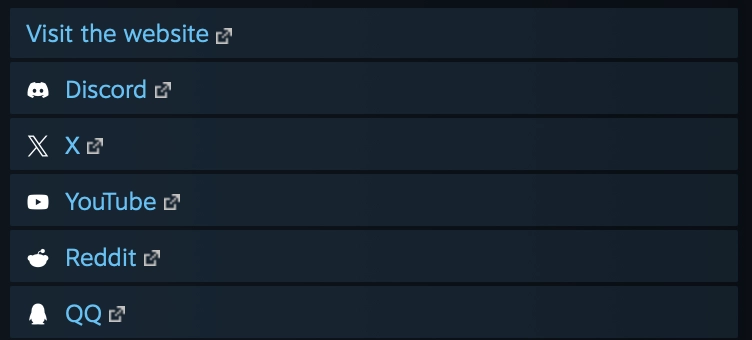
- The Discord Hub: Discord is your Warm Lead bucket. It’s where you collect feedback and announce "peaks" to funnel people back to Steam.
- The QR Code Loophole: While you can't use URLs, you can include a small Graphic/Banner at the top of your description that features a QR code or a clear "Join our Discord" call to action (though the link won't be clickable).
Your Steam page is a living document. Every time you get a new piece of art or a better gameplay clip, update the page. A static page is a dying page.
2. The Press Kit: Giving Media a Story to Write
When you reach out to journalists or content creators, you need to understand one truth: they are incredibly busy. They receive hundreds of emails a day. If they have to hunt for your release date, request a transparent logo, or struggle to find a clean screenshot, they will simply close your email and move on.
Your press kit is a single, easily accessible link (like a Google Drive, Dropbox, or a dedicated presskit page) that holds everything a writer needs to publish an article about your game in five minutes.
1. The Fact Sheet (The Skeleton)
This is a quick, scannable text document that breaks down the hard data of your game. Do not write a novel here. Keep it bulleted:
- Key Details: Release date, platforms, target price, developer name, and official links (Steam page, website).
- The Story Hook: Don't just list features, list angles that a journalist can build a story around. If your game is a high-fidelity take on a genre traditionally trapped in 2D graphics, write that down. If it utilizes unique dice mechanics to manipulate randomness, highlight it. Give them the headline for their own article.
2. The Core Assets (The Muscle)
- The Trailer: Provide a YouTube link for easy viewing, but also include a downloadable link to the high-quality raw file.
- Screenshots & Logos: At least 5–10 high-resolution, unedited gameplay screenshots. Include your game’s logo on a transparent background (.png) in both light and dark versions.
- Contact Info: A direct email where you actually respond, plus your studio's active social links.
The Modern Video Shortcut
If you are consistently creating vertical short-form videos (like TikToks, Reels, or YouTube Shorts), include a dedicated folder of these files for download. Clean, unwatermarked, high-energy vertical clips are gold for modern media outlets and gaming pages looking for quick social media content. If you make it easy for them to just grab a clip and upload it to their channels, your visibility will snowball fast.
3. The Wishlist Roadmap: Your Strategic Launch Timeline
In the industry, we talk about Marketing Beats. A beat is a specific moment where you shout as loud as possible to get a "Peak" of wishlists. In The Hard Way, we don't just hope for these peaks; we engineer them. The goal of this roadmap is to ensure that each event acts as a foundation for the next, building the momentum required to break through the noise of the 14,000+ games launching every year.
3.1 The Wishlist Economy: The 7,000 Milestone
Wishlists are the only metric that truly matters before launch. They are your "intent to buy" data, and they are the only language the Steam algorithm speaks.
- The Snowball Effect: More wishlists lead to more visibility in Steam’s "Discovery Queue" and "Similar Games" sections. This brings in more people, who wishlist the game, creating a self-sustaining loop.
- The "Popular Upcoming" Gate: The magic number is 7,000 wishlists. If you hit this milestone, Steam features you in the Popular Upcoming section on the front page about a week before your launch. This can bring in 500–2,000 additional wishlists per day right before you go live.
- The Commercial Reality: If you have real ambitions, do not launch before hitting 7,000 wishlists. Launching with 1,000 wishlists is "The Hard Way" to realize you just spent years on a project that won't recoup its costs.
3.2 The Survival Formula
Launch Wishlists x 0.2 = Week 1 Sales Units
If you need to sell 5,000 copies to survive, you need 25,000 wishlists. Math doesn't lie.
3.3 The Detailed Roadmap: Milestone by Milestone
1. The Announcement: Creating Initial Momentum
Never announce your game without a live Steam page to catch the interest. This is your first organic spike, and you need to make it count.
The Strategy: Collect as many contacts as possible before the reveal. Look for neighbour games - titles that play similarly to yours and follow their developers. Engage with them on X (Twitter), LinkedIn or elsewhere. When you announce, reach out to them, they are connected to the players of your genre and can help you spread the word.
The Press Blitz: Prepare a press release. This isn't just a "we are making a game" note, it’s a package containing your core features, a YouTube link to your trailer, and high-res screenshots. Find journalists who have reviewed similar games in major outlets and send it to them personally.
The Momentum Rule: Don't plan your demo or playtest too far from the announcement. You want to give players something to look forward to while the newness is still fresh.
2. The Steam Playtest: Your Feedback Loop
Steam provides a specific Playtest App that allows you to give access to the most motivated part of your community without affecting your main store page's statistics.
Closed vs. Open: A Closed Playtest allows you to hand-pick the number of players (e.g., 200–500). This makes it easier to digest feedback and fix major bugs. An Open Playtest serves more like a demo, but players are usually more forgiving because it’s labeled a "test"—and crucially, they cannot leave a public review that affects your score.
The Data Grab: Put a feedback form directly in the build (using Google Forms or a specialized tool). Ask about pacing, visuals, and progression. Use this phase to funnel players to your Discord—they will become your "Street Team" for launch.
3. The Demo: The Influencer Magnet
Only release a public demo after you have implemented the initial feedback from your playtest. You only get one chance at a first impression with influencers.
- Separate Steam Pages: Demos now have their own pages on Steam. This means they can be discovered independently, but it also means players can review them. Ensure the demo is polished!
- Incentivize the Return: Between every beat (Playtest → Demo → Next Fest), add something new. If you just fix bugs, your playtesters have no reason to play again. Add a new character, a new map, or a new power-up and announce it loudly. You want a "Peak" in active users, which triggers the algorithm to show your demo to new people.
4. The Steam Prologue: The "Double Launch" Strategy
A Steam Prologue is a standalone, free AppID that acts as a polished "taster" for your main game. While Valve has updated standard Demos to behave more like Prologues (allowing separate pages and reviews), the standalone Prologue remains a high-tier tactical choice.
Why use a Prologue? (The Benefits)
- The "Double" New & Trending: This is the biggest draw. A Prologue gives you a second chance to hit the front-page charts. When your Prologue launches, it appears in the "New & Trending" list of free games, exposing you to an audience that might never have seen your main page.
- Review Social Proof: Players can leave reviews on the Prologue. If you have 500 "Very Positive" reviews on your Prologue, it signals to the algorithm (and future buyers) that the full game is high quality.
- The Wishlist Funnel: The Prologue is a feeder. Every person who plays it should be hit with a massive "Wishlist the Full Game" button on the main menu and the end screen.
The Risks
Data from GameDiscoverCo shows that while Prologues can generate 10x more traffic than a standard demo, they carry risks:
- The "Free Game" Entitlement: Players are often harsher on Prologues. If it’s buggy or doesn't have enough content, you will get "Mixed" reviews that damage your brand before the main game even comes out.
- Maintenance Overhead: You are now managing two Steam pages. You have to moderate two forums and manage two sets of community hubs.
- The Demo Evolution: Since Steam updated the "Demo" system to allow for separate pages/reviews, the traditional Prologue is no longer "mandatory," but it is still a more powerful way to hijack the "Free Games" charts.
When to choose a Prologue
- Choose a Prologue if: Your game is highly "streamable" and you have enough polished content to offer 30-60 minutes of fun that feels like a complete experience.
- Stick to a Demo if: You want to keep all your traffic concentrated on a single page and you don't have the manpower to manage two separate launches.
5. Steam Next Fest: The Multiplier
This is the single most important event before release. You can only attend once, so your demo must be in its best possible shape. It happens three times a year (Feb, June, Oct).
- The Multiplier Rule: Never treat Next Fest as your announcement. It is a multiplicator. Usually, a successful Next Fest adds about 30% on top of what you already have.
- The Math: If you enter with 10k wishlists, you might end with 13k. If you enter with 1k, you’ll be buried at the bottom of the genre list and overshadowed by bigger devs.
- Timing: Ideally, attend a few months after your initial demo release so you can promote the "New Content" you've added since the last beat.
6. The Release: The Biggest Peak
The first release (whether Early Access or 1.0) is the highest stakes moment in your games life. This is the biggest beat and the highest peak you will ever have, if this goes wrong, it is incredibly hard to recover. You have one chance to hit the "New & Trending" lists and stay there.
- Strategy & Timing: Choosing a date is a balancing act. Don't overthink it to the point of paralysis - in the modern market, there is always something releasing. However, you must avoid the Oxygen Suckers. If a AAA title or a massive "Neighbor" in your genre is releasing on a specific Tuesday, don't launch that day. You don't need all the eyes on the internet (that's impossible for an indie), you just need the eyes of your genre's fans. If they are all busy playing a blockbuster, they won't be looking for you.
- The "Day 1" Kickstart: Use everything you’ve built - dev friends, wishlisters, and your Discord community. In the first few hours, you need as many sales and positive reviews as possible. This isn't about cheating the system, it's about providing the positive signal the Steam algorithm needs to push you to the "New & Trending" front page.
- The Early Review Push: It is vital to have your friends ready to buy the game and provide honest, positive reviews in the first few hours. This isn't about spoiling or faking sentiment, it’s about technical survival. Steam’s algorithm needs a cluster of positive signals early on to decide if it should push you to the front page. Those first 10-50 reviews are the difference between an organic explosion and a quiet death.
Velocity is everything. 1,000 wishlists in 1 week is significantly more powerful than 1,000 over 6 months. Plan your beats to create spikes, then use those spikes to climb the Steam charts. If your math shows you are nowhere near your target, delay the launch a bit. Polishing a game for 3 months is cheap, launching a failed game is the most expensive mistake you can make
4. The Influencer Game: Finding and Pitching to Creators
In the modern landscape, traditional gaming press is no longer the only gatekeeper. While major outlets still provide legacy visibility and industry credibility that helps with awards and platform featuring, Creators - streamers and YouTubers are the high velocity engine of indie discovery.
A single video from the right creator can change your studio's trajectory overnight. However, don't fall for the viral lottery myth. When you hear about a game that suddenly blew up because of a big streamer, you are usually seeing the tip of an iceberg made of months of manual outreach, relationship building, and strategic timing.
When to Reach Out: Timing is Everything
Don’t wait until launch day to talk to creators. You want to time their coverage to hit exactly when your peaks are happening.
- The Lead-Up: Reach out 2–3 weeks before you release a Public Playtest or a Demo.
- The Goal: You want their video or stream to go live the moment the Download button appears on Steam. This creates a direct funnel - a viewer sees the fun, clicks the link in the description, and immediately downloads the demo.
- The Build: Only reach out when you have a stable, polished build. If a creator encounters a gamebreaking bug in the first 5 minutes, they won't just stop playing, they might never look at your studio again.
The Pitch: Stop Being a Robot
Creators are people. They can smell an automated template from a mile away. If you want a response, you have to prove you know who they are.
- Research Your Genre: Don't waste time pitching a horror game to a builder who only plays The Sims. Use tools like SullyGnome or Woovit, but ultimately, manual research is best. Watch their videos. See if they enjoy games like yours.
- Keep it Short & Visual: Creators are busy. Don't send a 5-paragraph lore summary.
- The Hook: A one-sentence pitch (Your "Player Elevator Pitch").
- The Visuals: Embed a 30-second gameplay trailer and 2-3 high-impact screenshots.
- The Call to Action: Provide the key immediately. Don't ask "Would you like a key?" Just give it to them.
- Low Friction: Make it incredibly easy to jump in. Ideally, don't hide the game behind Beta branches or complex passwords. Give them a Steam Key, a link to the Press Kit, and let them play.
Guerrilla Tactics: Getting Noticed by the Giants
Sometimes, the standard email just won't cut it, especially for massive influencers who have managers filtering their inboxes. In The Hard Way, we aren't above a little creative "guerrilla" marketing.
The Donation Door-Opener
If you feel there is a slim chance a creator will see your email, you can try the Direct Interaction method. Most streamers use "Text-to-Speech" (TTS) for donations, meaning your message is read aloud to the creator and thousands of viewers instantly.
- The Strategy: Send a small donation ($5–$10) during a live stream. You don't need to be salesy. You have two honest ways to play this:
- The "Honest Developer" Approach: "Hey [Name], I'm a dev working on a [Genre] game similar to [Game being played]. I'd love to hear your thoughts on it sometime! [Steam Link or Game Name]."
- The "Fellow Fan" Approach: "This stream is great! If you like this, you should check out [Game Name] later, it looks right up your alley. [Link]."
- Why it works: It’s personal, it’s immediate, and it often triggers an "Oh, let me look at that Steam page" reaction live on camera. If the chat starts saying "That looks cool," the streamer is much more likely to actually check their inbox for that key you sent earlier.
Building the Relationship (The "Beaver Hat" Strategy)
Marketing is about numbers, community is about stories. If you treat creators as partners rather than just traffic sources, magic happens.
Case Study: The Beaver Hat
While working on a nature-building game, we reached out to a creator who posted an initial video. During the video, he couldn't tell if an animal was a beaver or a squirrel, and his comment section was roasting him for it.
For our next marketing beat, we added a small cosmetic - a tiny hat for the beaver that matched the hat the creator wore in his profile picture. He loved it. Because we listened and showed that we cared about his specific experience, he felt like part of the development. He played the game multiple times after that because he felt a personal connection to the project.
This is how you turn a one-off video into a long-term champion. Listen to their streams, read their comments, and find small, low-effort ways to acknowledge them in-game.
5. Organic vs. Paid: The Visibility Engine
Marketing an indie game in 2026 is a balancing act of time and money. For a small team, you physically cannot be everywhere. You have to decide: do you spend your limited hours chasing viral organic posts, or your limited dollars on targeted paid visibility?
In The Hard Way, we don't pick one, we use them for different purposes.
5.1 Organic Content: The "Authenticity" Trap
Organic social media (TikTok, X/Twitter, Instagram) is great for building a vibe, but it is a massive time sink.
- The Bandwidth Problem: Every platform requires a different format. TikTok needs vertical video, X needs short-form text and images. If you spend 20 hours a week editing clips and replying to comments, you aren't making your game.
- The "Viral" Lottery: Organic reach is often at the mercy of the algorithm. You might post 50 times to silence, then hit one viral post that brings in 5,000 wishlists. It’s hard to build a business plan on maybe.
- Strategy: Keep organic simple, or don’t do it at all and stick to just a few select channels like Discord or Steam Community Hub. Use your limited time to post behind-the-scenes clips, funny bugs, or "Which art style do you prefer?" polls. This content shows there is a human behind the screen, but you must ensure it doesn't become your full-time job.
5.2 Paid Ads: Precision Targeting
Paid ads allow you to bypass the algorithm and put your game directly in front of your Neighbors.
- Filtering by Audience: Don't just blast ads to all gamers. Look at your Neighbors (the games similar to yours) and target their fans. If you’re making a sci-fi RTS, find where the StarCraft and Stormgate players hang out.
- Cost-Efficiency: Paid ads let you buy data. Spend $50 to see which trailer thumbnail gets more clicks. If one image has a 5% click-through rate and another has 0.5%, you just saved yourself months of marketing the wrong visual.
- The Patience: You must run an ad for at least 3 to 5 days without touching it. The algorithm needs to fail a few times to learn who actually clicks. Only after this "Learning Phase" should you evaluate and change your strategy.
5.3 The Reddit Way: The Art of the Non-Ad
Reddit is a goldmine for gamers, but it’s also the place where traditional marketing goes to die. Redditors hate being sold to. If your ad looks like a polished corporate commercial with "fluffy" marketing text, they will ignore it, or worse, roast it in the comments.
- The "Regular Post" Aesthetic: The most successful Reddit ads don't look like ads at all. They look like a developer sharing a cool thing with a friend.
- The Wrong Way: "Experience the most revolutionary robot city builder of 2026! Wishlist now and get exclusive skins!" (Instantly ignored).
- The "Hard Way": "I'm building a city builder with robots where you can actually customize their AI. What do you think of this animation?" (High engagement).
- The Headline is Everything: Use simple, direct descriptions. "Cool city builder with robots" works because it’s exactly what the person sees. It feels honest.
- Engagement is Key: If you run an ad, stay in the comments. Answering a question like "Will this run on Steam Deck?" right in the ad thread turns a viewer into a fan instantly.
6. Steam Next Fest Mastery: The Super Bowl of Wishlists
Steam Next Fest is the single most important marketing event in your pre-launch cycle. It occurs three times a year (February, June, and October) and represents the moment when the Hard Way methodology meets the biggest stage on Steam.
The Golden Rule: Steam Next Fest does not uncover hidden gems. If your game is struggling to get attention before the fest, it will likely be buried during it. If you enter with high velocity, the festival acts as a massive multiplier.
6.1 The Multiplier Mindset
Next Fest is designed to boost games that already have eyes on them.
- The Reality Check: Thousands of games participate every year. The Steam algorithm prioritizes games that bring their own crowd.
- The Math: On average, a successful Next Fest adds about 30% on top of your existing wishlists. If you enter with 10,000, you leave with 13,000. If you enter with 100... you leave with 130.
- Velocity is King: Steam looks at your wishlist growth before the fest starts. If you are trending heading into day one, you will be placed at the top of your genre lists.
6.2 The Timeline: Don't Debut at the Fest
The biggest mistake indies make is launching their demo on the first day of Next Fest.
- The 1-2 Month Lead Time: Publish your demo 1–2 months before the festival.
- Why? You need time to find game-breaking bugs, fix confusing tutorials, and gather initial feedback.
- Velocity: Releasing the demo early allows influencers to play it and drive wishlists before the fest, giving you the velocity needed to hit the top of the charts on day one.
- The "Leave it Up" Rule: Keep the demo live for a few weeks after the festival ends. Many creators and players "collect" demos during the week and play them slowly afterward. Don't cut off your momentum.
6.3 The Content Update: Giving a Reason to Return
If you already have a demo out, you need a beat for the festival itself.
- The Refresh: Modify the demo for Next Fest by adding new content (a new boss, a new map, or a new character).
- The "Returning Player" Hook: If you don't add something new, the players who already tried your demo (and the creators who already streamed it) have no reason to help you create that day one peak. A "New Content Update" gives them a reason to make a second video or a second post.
6.4 Technical Survival Tips
Steam features a Broadcast section at the top of the Next Fest pages. Staying at the top of this list is a major traffic driver.
- The Hack: You want a high-quality video of gameplay looping 24/7.
- The Tool: Use a service like Robostreamer.
- Instead of leaving your own PC running (and praying your internet doesn't flicker), you upload your video to Robostreamer, and it streams directly to Steam’s servers on a loop.
- Start your broadcast 24 - 48 hours before the fest starts. Concurrent viewer counts take time to build. starting early ensures you hit day one with an active viewer count that signals the algorithm to keep you visible.
Enter Steam Next Fest as the final step in your marketing journey. This is the "Grand Finale" for your demo. If your demo isn't polished, or if your wishlist velocity is flat, wait. You only get one shot at a Next Fest per AppID. Don't waste your Super Bowl on a game that isn't ready to win.
7. Community Building: Turning followers into a team
In The Hard Way, we don't just build a following, we build a Core Team. The goal of community building is to shift your players from being passive observers of your devlogs to being active participants in your studio's journey. When players feel they have a hand in the game's creation, they stop being customers and start being advocates.
7.1 Shifting the Perspective: From Passive to Active
Most indie devs treat social media like a one-way megaphone. They post a screenshot and wait for likes. This is a mistake. To build a community, you must treat your players like they are part of the development team.
- The Goal: Create an environment where "we" refers to both the devs and the community.
- The Psychology: People are much more likely to defend and promote something they helped build.
7.2 The Feedback Funnel: Closing the Loop
To turn a browser into a fan, you need a friction-less path for them to talk to you.
- The Playtest Hook: Every time you release a Playtest or Demo, embed a Feedback Form (Google Forms or Typeform) directly into the main menu.
- The Discord Link: At the end of that form, include a direct invite to a specific "Feedback" channel on your Discord. This funnels the most motivated players (those who actually played and had opinions) into your private hub.
7.3 The Invested Core: Implementing Player Ideas
Nothing builds loyalty faster than a developer saying, "I saw your suggestion in the Discord, and I've added it to the game."
- The Feedback Cycle: Create a dedicated channel on Discord for #bugs and #suggestions.
- Visibility: When you implement a player's idea or fix a bug they reported, tag them in the announcement.
- The Result: This creates a strong and invested community that feels heard. These players will begin to act as your first line of defense, answering questions from new members so you don't have to.
7.4 The "Street Team" Evolution: Autonomy and Testing
Once you have 50–100 of these power users, you have a high-value resource.
- The Secret Branch: Create a private Discord role (e.g., @Alpha-Testers) for your most helpful members. Give them access to a playtest Steam branch where they can test features weeks before anyone else.
- The Benefit: These people will take the time to break your game for free because they care about the project's success. They become the team that kicks off your launch day momentum.
7.5 Technical Setup: The Discord Infrastructure
Don't overcomplicate your server. A "Hard Way" Discord needs only a few things to function:
- Onboarding: A #welcome channel that tells them exactly how to get the demo or join the playtest.
- The Devlog: A one-way channel where you post raw, unpolished progress. People love seeing the "ugly" parts of dev.
- The Help Hub: As mentioned in 6.3, a place for bugs and suggestions.
- Role Rewards: Use roles to recognize people. A "Playtester" role should be a badge of honor that grants access to those private channels.
Community management isn't about being a "PR person." It's about being a peer. If you are honest about your struggles (e.g., "This boss AI is kicking my ass, any ideas?"), your community will rally around you. Vulnerability builds more loyalty than corporate polish.
Chapter Wrap-Up: Engineering the Avalanche
- The Steam Page is Your Lifeblood: Every effort you make - be it an ad, a tweet, or a streamer shoutout, is wasted if your Steam page doesn't convert. Capsule Art, Tags, and the Short Description are the bedrock of your success.
- Velocity > Volume: Remember that 1,000 wishlists in a week tells the Steam algorithm you are a "Winner." 1,000 wishlists over six months tells the algorithm you are "Static." Plan your Marketing Beats to create peaks, not flat lines.
- The 7,000 Milestone is Non-Negotiable: If you want a commercial career, do not launch without hitting the "Popular Upcoming" gate. The math ($Wishlists \times 0.2$) is your survival forecast.
- Creators are Partners, Not Targets: Whether through a personal pitch or a "Guerrilla" donation, treat influencers as human beings. A "Beaver Hat" level of personalization will always outperform a generic email blast.
- Next Fest is Your Super Bowl: Enter it as your final marketing act, not your first. Use it as a multiplier for the momentum you have already built.
- Community is Your Street Team: A Discord full of active participants is worth more than a million passive followers. If your players feel like they are part of the team, they will do your marketing for you.
There is a common myth that "Good games sell themselves." They don't. In a market where 40 games launch every day, even masterpieces can die in silence. Marketing isn't something you do after you finish the game; it is a core pillar of development. If you aren't building an audience while you build the game, you are building a hobby, not a studio.
The Backend Trenches (Steamworks)
While the official Steamworks documentation is vast, it can often feel like a labyrinth of technical jargon and legacy UI. Many of the most important pro tips, the ones that prevent launch-day disasters, aren't even written in the manual.
This chapter is your practical field guide to the plumbing of the Steam store. We are moving away from theory and into the actual buttons you need to click to get your game into the hands of players.
What we will cover in this chapter:
- 1. Set Up Your Developer Account: Navigating the legal, tax, and banking hurdles to become an official Valve partner.
- 2. Create Your Application: Paying the product fee and generating your first AppID.
- 3. Setting Up Demos & Playtests: How to use Steam's testing tools to build momentum without risking your main store rating.
- 4. Preparing for Publishing: A step-by-step walkthrough of the "Store Presence" requirements and the SteamPipe build upload process.
- 5. Monitoring the Machine: How to read the backend data, interpreting your wishlist velocity, tracking marketing traffic, and understanding your financial reports.
1. Setting Up Your Developer Account
This is the moment your project transitions from a private passion to a professional product. To become a Steam Partner, you are establishing a formal relationship with Valve Corporation, which allows you to use their infrastructure to sell your game.
1.1 The Identity Decision: Individual vs. Company
When you begin the signup process at partner.steamgames.com, you must decide how you are representing yourself.
- The First Choice: You will see an option to sign up as a "Game Developer or Publisher." This is the correct choice for most indies. Even if you are a one-person team doing everything yourself, you are acting as your own publisher in the eyes of Steam. This selection ensures you are directed toward the correct digital paperwork (the Steam Distribution Agreement).
- Individual: You are signing as yourself. All tax documents and bank accounts must match your legal name.
- Company (LLC/Corp): You are signing as a legal entity. This is the "Hard Way" recommendation for anyone with commercial ambitions. It protects your personal assets and makes future scaling (revenue sharing with partners or contractors) much cleaner.
- The Match Rule: The name on your Steamworks account MUST exactly match the name on your bank account and your tax ID. If they do not match, Valve’s automated verification will fail, and you could be stuck in support-ticket limbo for weeks.
1.2 The Paperwork Trail
To get verified, you must complete three distinct sections. Do not rush these, errors here will halt your ability to receive payments.
- Pillar A: Digital Paperwork: You will sign a Non-Disclosure Agreement (NDA) and the Steam Distribution Agreement. Read them. They define the 30% cut Valve takes and your responsibilities as a developer.
- Pillar B: Bank Account Information: You need your IBAN and SWIFT/BIC codes. Steam pays out monthly (around the 30th), but only after you’ve cleared a $100 minimum threshold.
- Pillar C: Tax Validation: You must complete a digital tax interview.
- For US Devs: Standard W-9 form.
- For International Devs: You will fill out a W-8BEN form. This is critical to ensure you aren't double-taxed based on treaties between the US and your home country.
2. Create Your Application
Once your developer account is verified and ready, it’s time to actually carve out a space for your game on the Steam servers. This is where you move from being a "Partner" to being a "Creator."
2.1 Finding the "Create New App" Button
When you log into your Steamworks dashboard, look at the right-hand sidebar. You will see a prominent button labeled "Create a new application" Before you can proceed, Steam requires you to purchase a Steam Direct Fee.
- The Cost: $100.00 USD.
- What it covers: This is a one-time fee per application. It grants you credit to create one AppID.
- Flexibility: You can use this credit for a game, a piece of software, or even a video/movie.
- Naming: You will be asked to enter a name for the application. This name can be changed later**.** If your project currently has a working title, you can use that and update it once your branding is finalized.

2.2 The AppID: Your Game’s DNA
As soon as the fee is processed and you name your project, Steam will assign you an AppID. This unique 6 or 7-digit number is the "Social Security Number" of your game.
- It dictates the URL of your store page.
- It is used in your code to trigger Achievements and Cloud Saves.
- It is the folder name for your builds on Valve's servers.
2.3 The Release Checklist
Once the app is created, you will be presented with the App Dashboard. Your main goal here is to tackle the Checklist displayed at the top. Until every item on this list is completed and approved, the Publish button will remain locked.
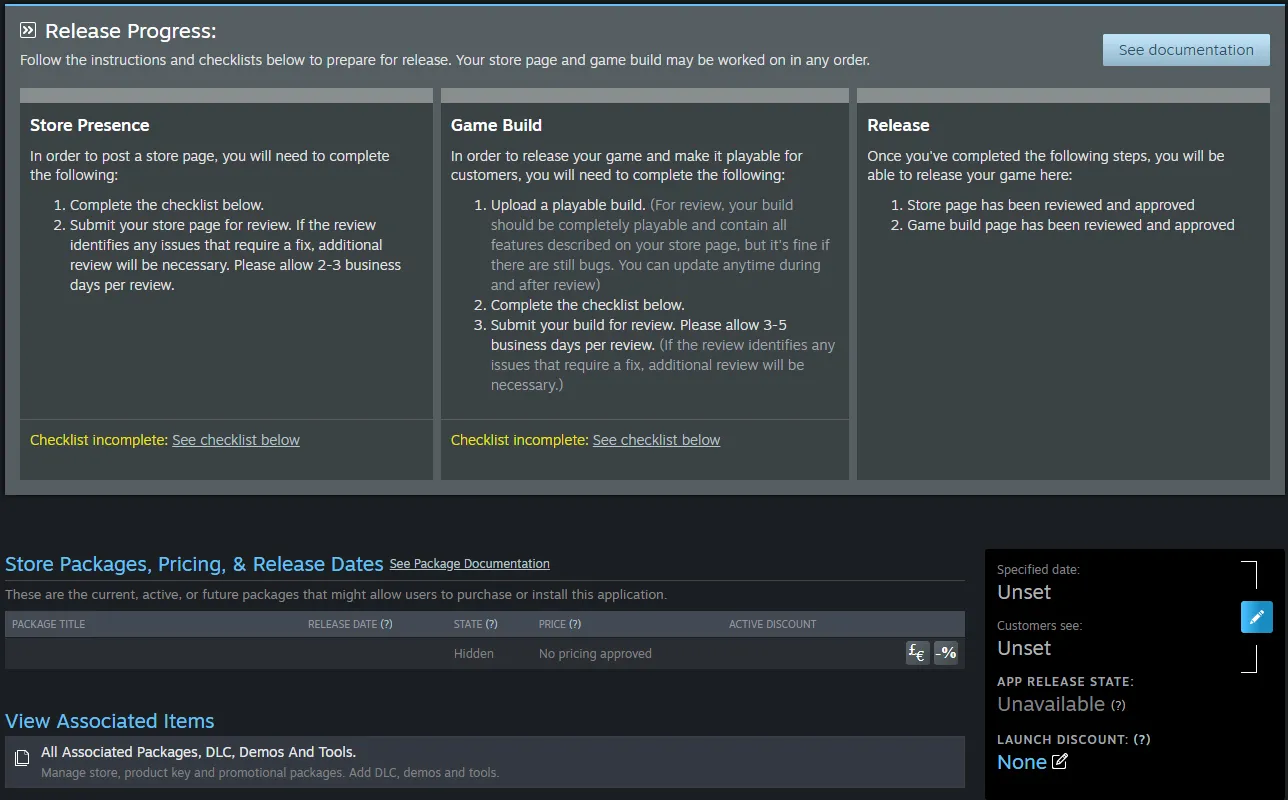
The checklist is logically divided into three primary pillars:
| Store Presence | The Frontend | This is the "Marketing" side. It includes your Capsule Art, Screenshots, Trailers, and Descriptions. This is what players see when they search for you. |
| Game Build | The Technical | This is the "Engineering" side. You must upload your actual game files (the Build) and configure your "Depots" (the containers for those files). |
| Release | The Final Step | Once the first two pillars are green-lit, this section handles the final "Publish" sequence, including setting your price and launch date. |
Treat these checklists as your roadmap. You don't need to finish them all at once. In fact, you should focus on Store Presence first so you can get your "Coming Soon" page live and start collecting wishlists while you are still working on the Game Build.
It is important to remember that Valve’s team manually reviews your progress.
- Store Page Review: Usually takes 2–5 business days.
- Build Review: Usually takes 2–5 business days.
- The Golden Rule: You cannot release your game until at least 30 days after you paid the fee, and your store page must be live as "Coming Soon" for at least 2 weeks before the "Release" button becomes active.
The release checklist is strictly for the Public Store Launch. You can still utilize the backend for development and testing while your store page is being polished.
- Steam Keys: Even if your checklist is 0% complete, you can still request Internal Testing Keys. This allows you to give the game to team members or private testers to ensure the Steam integration (like Achievements or Steam Cloud) is working.
- Playtests & Demos: As we will cover in 3., you can set up and run a Steam Playtest or a Demo while your main application is still sitting in the Draft stage.
Don't let a missing piece of capsule art stop your technical progress. You can upload builds, test your Steamworks API, and run closed playtests long before you ever "Publish" your page to the public. Use this time to break things and find bugs while the "Coming Soon" page is still under construction.
3. Setting Up Your First Playtest and Demo
Navigating the Steamworks dashboard to find where to actually "create" a new version of your game can be confusing. Steam treats Playtests and Demos as separate entities linked to your main "Base" application.
3.1 Finding the Creation Menu
To start, log in to your Steamworks dashboard and select your main game from the list.
- On the right-hand sidebar of your App Landing Page, look for the section titled "All Associated Packages, DLC, Demos, and Tools."

- Click on this link. You will see a button to "Add Demo" or "Add Playtest app."
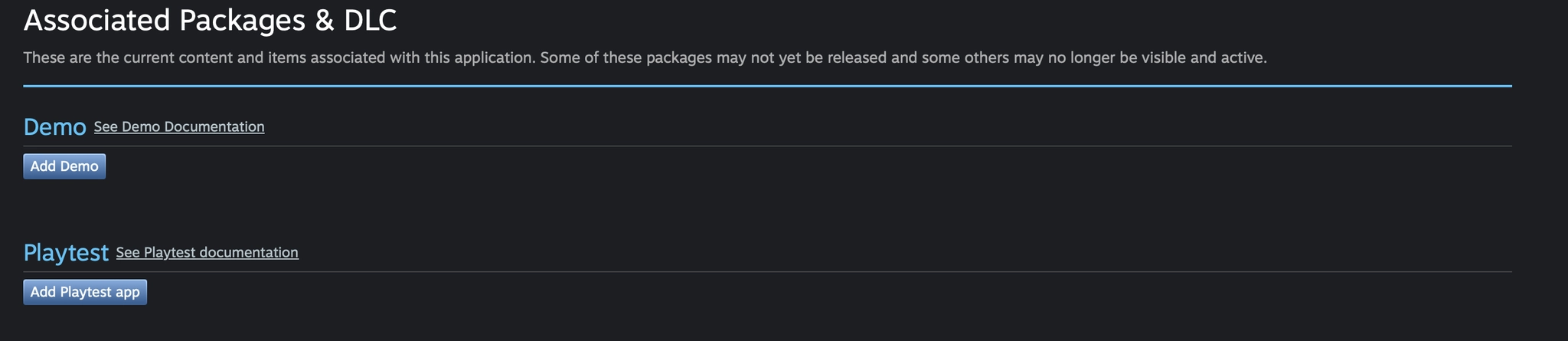
3.2 Steam Playtest: The Safe Laboratory
A Steam Playtest is a separate AppID that lives on your main store page. It is the best way to get feedback because it cannot receive public reviews that affect your main store or demo page score.
Step 1: Setup and Approval
Just like your main game, a Playtest requires Store Presence (at least basic graphics/capsules) and a Game Build.
- You must submit these for a brief review by Valve before you can go live.
- Even for a Closed Playtest, you must technically Release the Playtest app in Steamworks so the system can distribute the files.
Step 2: Choosing Your Access Model
You have three primary ways to manage who plays:
- Manual Keys: You can request a batch of Playtest Keys from Steam. You can then hand-deliver these to friends, family, or specific influencers. This is the most private method.
- Closed Playtest (Request Access): A "Join the Playtest" button appears on your Steam page. Players click it to "Request Access." You, as the dev, then go into the backend and click a button to "Add 100 Players" or "Add 500 Players."
💡 Why this is great: It allows you to control the influx. If you are overwhelmed with feedback, you stop adding players. If you need more data, you add another 1,000.
- Open Playtest: Anyone who clicks the button gets in instantly. This is great for stress-testing servers or getting massive amounts of data quickly.
3.3 The Steam Demo: The Public Stage
A Demo is now much more powerful on Steam. It can have its own store page, appear in "New & Trending" for Demos, and even receive reviews.
Setup Instructions:
- Creation: After creating the Demo app in the "Associated Packages" section, you must fill out its own Store Checklist.
- Assets: While you can "inherit" some assets from the main game, we recommend creating a unique "Demo watermark” on your capsule art so players know exactly what they are downloading.
- The Build: You will upload the Demo build to its own AppID via SteamPipe. Warning: Ensure your Demo build is polished! Because Demos can now be reviewed, a buggy demo can lead to a Mixed rating before your main game even launches.
Once your game is officially released, you have a critical UI choice to make in the Steamworks backend regarding your Demo. In Edit Store Page → Special Settings, there is an option to display your demo as a prominent green box directly above the "Buy" button. It can actually lower your immediate sales. Because the green box sits exactly where players expect the "Add to Cart" button to be, you are essentially putting a stop sign in front of a customer who was already prepared to pay.

Use the Playtest App for your Milestone 2 and 3 feedback loops (More in Chapters like Marketing & Visibility or Game Launch Strategy). People are much more forgiving of bugs when they see the word "Playtest." Use the Demo App for your Milestone 4 phase once the game is polished. This keeps your early "messy" development away from the public review system.
4. Preparing for Publishing: Store Presence & SteamPipe
Preparing your game for the world is a two-front war. On one side, you have Store Presence (what the players see), on the other, you have SteamPipe (how the files get to their computers). Both have separate checklists in the Steamworks backend that must be green-lit before you can launch.
4.1 Store Presence (The Frontend)
On the right-hand sidebar of your App Landing Page, you will see a list of categories under "Your Store Presence." You must navigate through these one by one.
- Base Info: Fill in your Developer and Publisher names and link your social media
- System Requirements: This is often the tricky part to guess. The Neighbor Strategy: Look at 3-4 games in your genre with similar fidelity. If they list a GTX 1060 as the minimum, and your game runs fine on one, use that as your baseline. If you're unsure, find a low-end laptop, if it’s playable there, that’s your "Minimum."
- Release Date: If you don't have a locked date, set the "Internal" date to something far in the future and set the "Public" display to "To Be Announced" or just the year.
- Languages: Check every language your game supports.
- The Reach Multiplier: Don't just translate the game, translate your Steam Page. Translating your descriptions and bullet points into the most popular Steam languages (Chinese, Spanish, French, German etc.) significantly widens your reach and signals to those global audiences that you care about them.
- Descriptions, Capsules, and SEO:
- We covered the "Hook" and "Player Value Pitch" in the Marketing & Visibility chapter.
- Tag Borrowing: Use your "Neighbor" games to build your tag list. If players of Game X like your genre, ensure you have the same top 5 tags so you show up in their "More Like This" section.
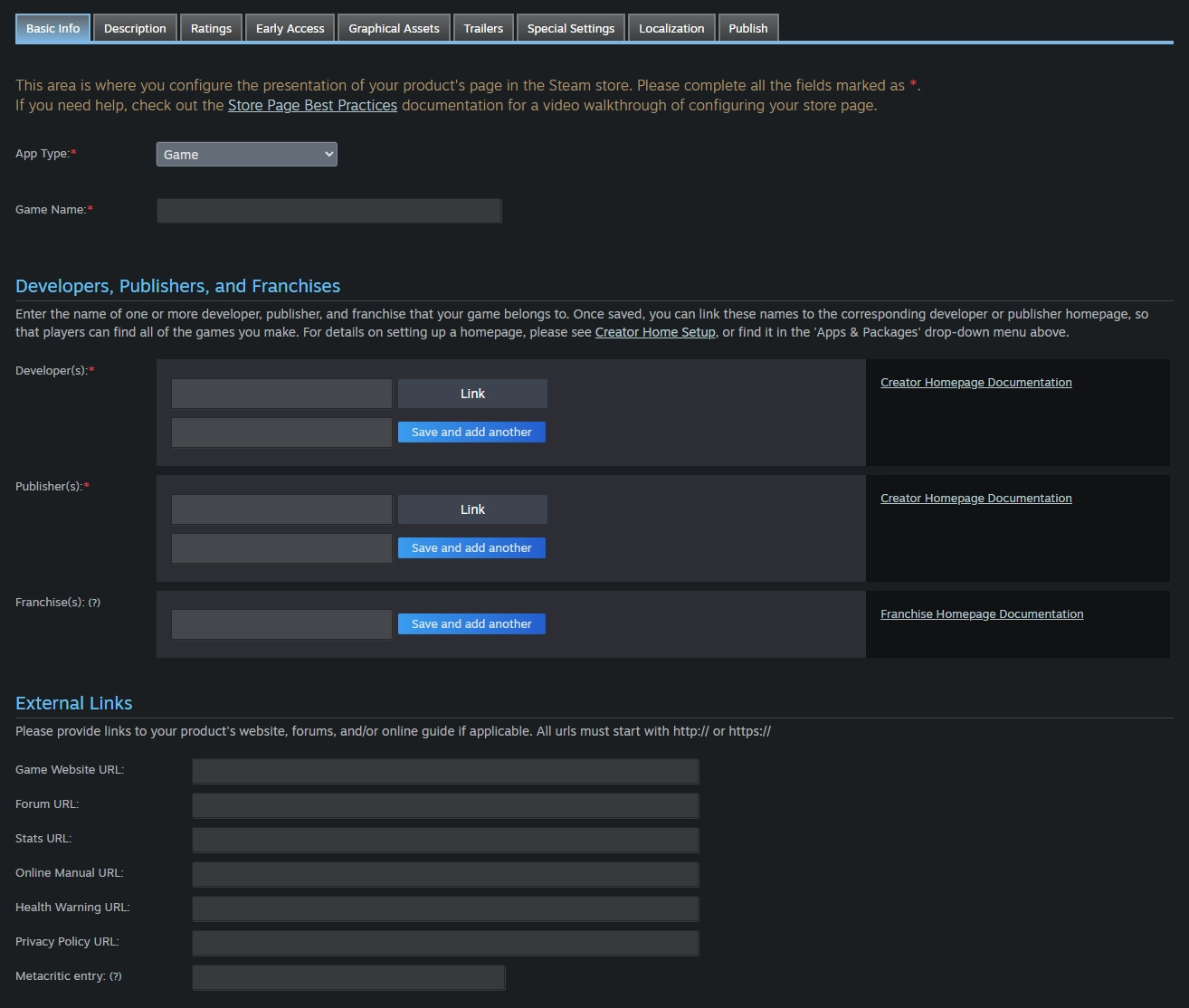
4.2 Supported Features (The Technical Polish)
Under the "Edit Steamworks Settings" -> "Application" tab, you can enable features that players have come to expect as standard.
- Cloud Saves: This allows players to switch between their PC and a Steam Deck without losing progress. Once enabled, you must set two numbers: Byte Quota (the total size of all save files) and Number of Files (how many save slots/files a single user is allowed). Most indies set this high enough to be safe (e.g., 100MB and 100 files).
- Achievements: These are excellent for "Completionist" motivation and player retention. Be aware that adding achievements requires extra code work and unique art assets (icons for both "Locked" and "Unlocked" states). Don't over-promise these if you are tight on time.
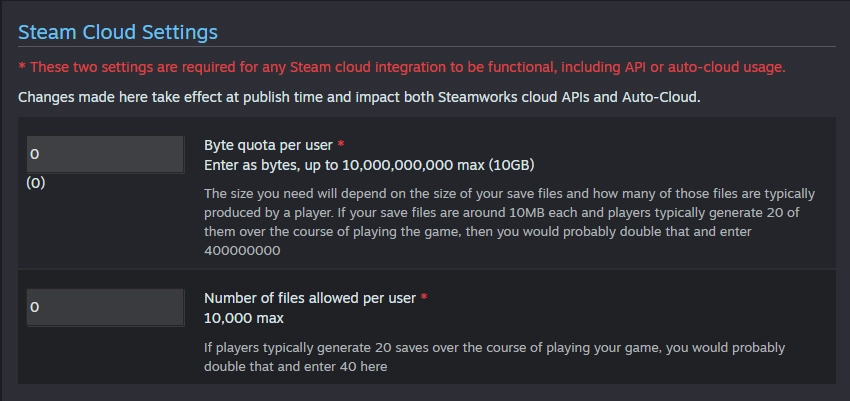
4.3 SteamPipe (The Backend Build)
The "Game Build" checklist is entirely separate from the store page. This is where you manage the actual delivery of your files.
- Configuring Depots: A Depot is a bucket of files. You can create different buckets for Windows, Mac, or Linux. Steam bundles these together so that when a Windows user hits "Install," they only get the Windows bucket.
- Uploading the Build: Steam uses the Steam SDK (SteamCMD) to push your files to their servers.
- By default, every app has a "Default" branch. Once your game is released, any build you "Set Live" on the Default branch is pushed to every single player immediately. Never push to Default without testing on a private beta branch first.
- Tutorial Resource: For a detailed, step-by-step walkthrough of how to use the Steam SDK and actually push your first build, I highly recommend this guide: How to Upload Your Build to Steam.
5. Monitoring the Machine: Data, Wishlists, and Analytics
Once your store page is live and your marketing engine is running, you need to understand the signals the Steam backend is sending you. Steamworks provides a lot of data, but it is notorious for being "imperfect." In The Hard Way, we don't look for exact numbers; we look for Ratios and Velocity.
5.1 Tracking Wishlists (The Primary KPI)
Wishlists are the single most important metric for an indie developer. They represent your potential sales before launch.
- Where to find it: Navigate to your App Landing Page → Financial Access → Sales & Activation Reports.
- The Table: You will see a daily breakdown of activations, returns, and most importantly - Wishlists.
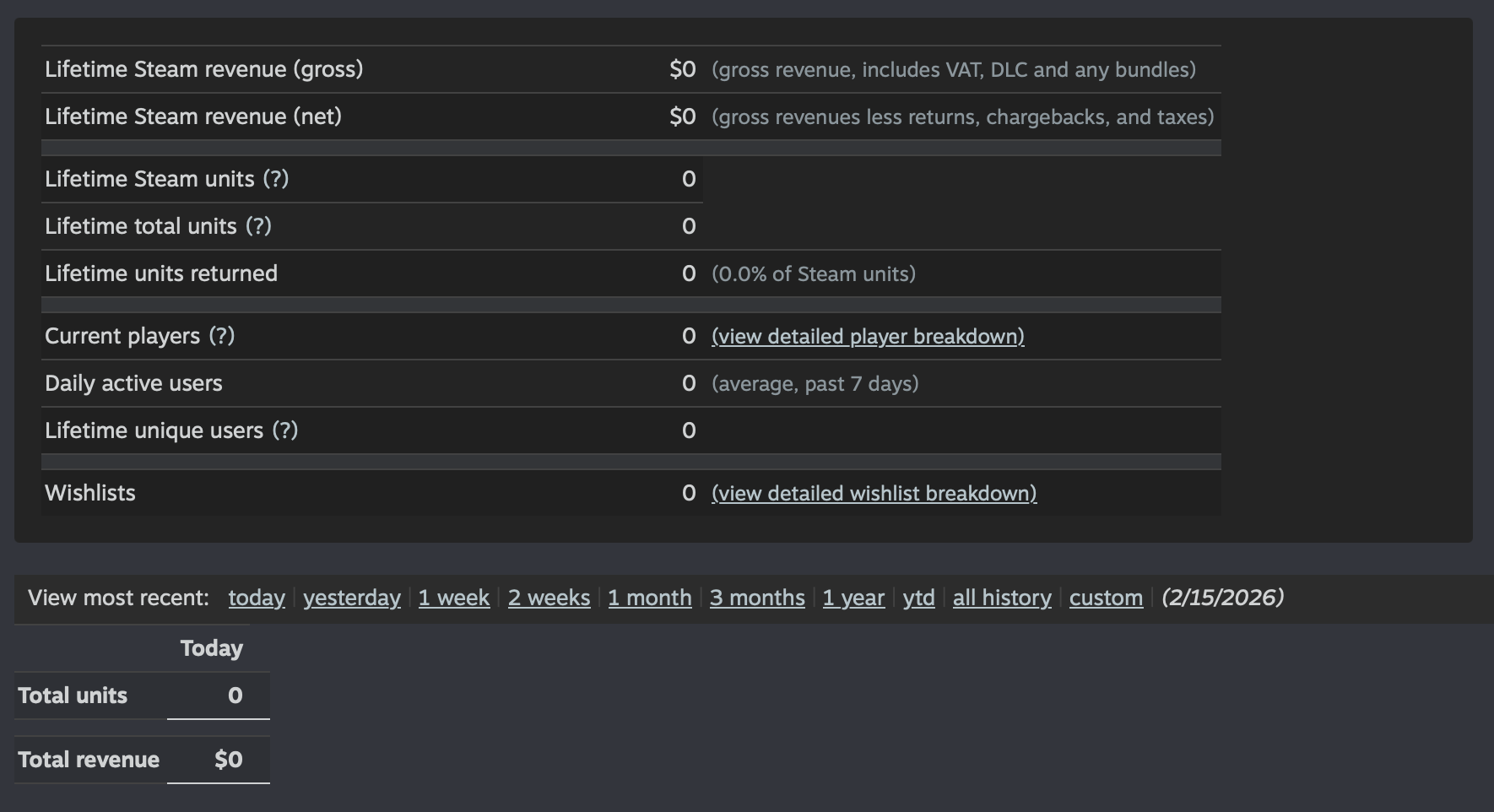
Reading the Numbers:
- Wishlist Additions: How many people added the game that day.
- Wishlist Deletions: How many people removed it (this is normal, don't panic unless it spikes).
- Wishlist Purchases & Activations: How many people actually converted and bought the game from wishlist.
- The Goal: You want to see "Organic Baseline" growth (e.g., 10–20 a day) punctuated by massive spikes from your marketing beats (Influencers, Reddit posts, or Next Fest).
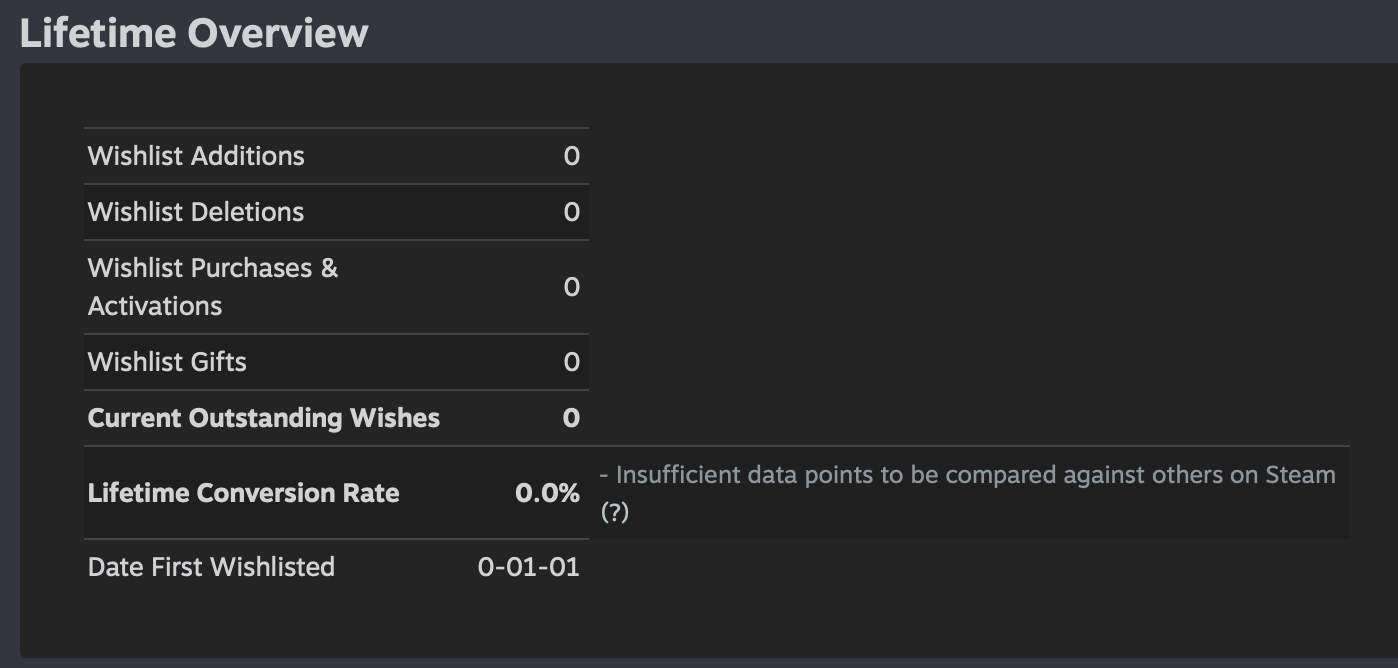
5.2 Traffic & The UTM Analytics Problem
Steam provides a section under Marketing Tools & Data → Marketing & Visibility that shows you where your traffic is coming from (Steam Search, External Discovery, etc.).

Few years back, Steam introduced UTM Analytics to replace the old Google Analytics integration. This allows you to create unique "Trackable Links" for your ads, social media posts, or influencer campaigns.
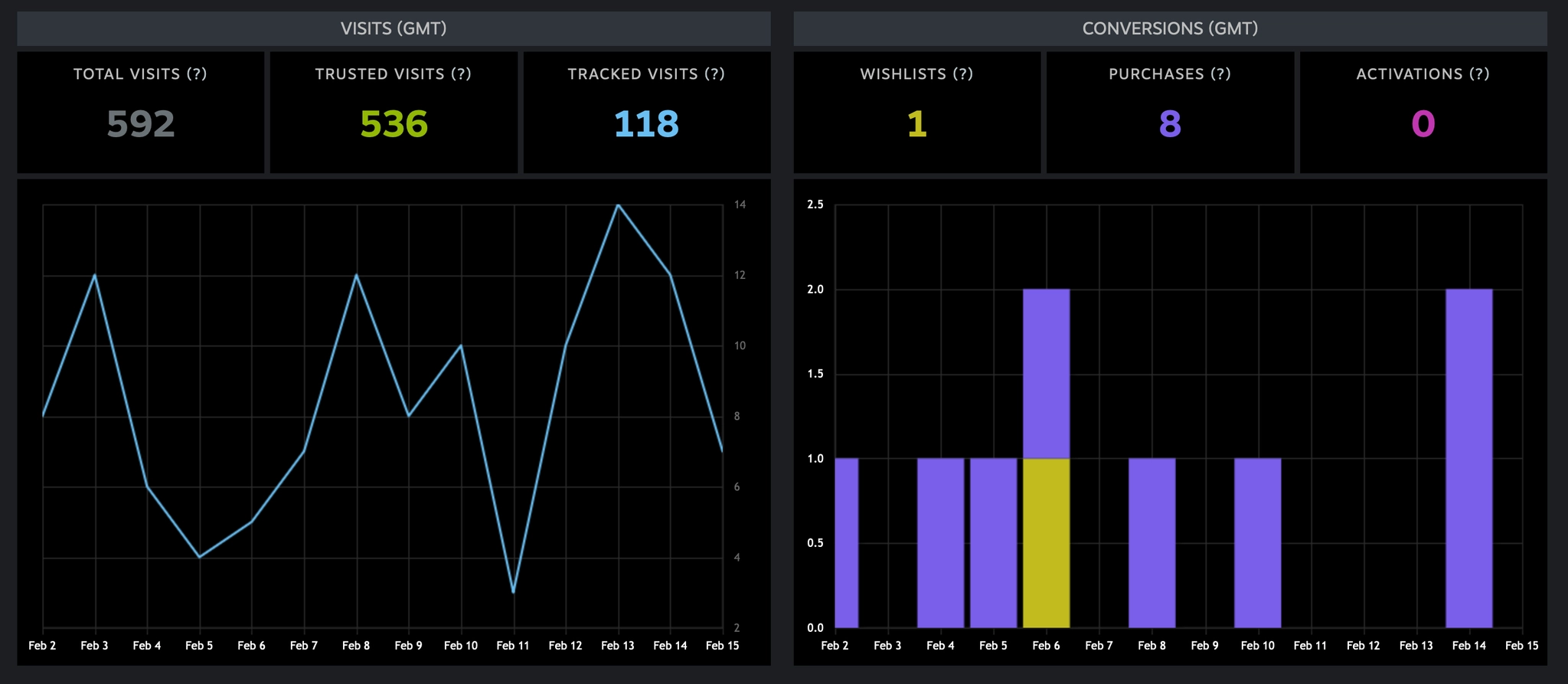
Steam’s UTM tracking is notoriously inaccurate. Valve is extremely strict about user privacy and does not track users across the store as aggressively as Facebook or Google.
- The Discrepancy: You might see 100 new wishlists in your "Sales Report" after a specific ad campaign, but the UTM dashboard only shows 20 "Tracked Wishlists."
- How to use it: Treat UTM numbers as a Relative Ratio, not an absolute truth. If Link A shows 50 clicks and Link B shows 5 clicks, you know Link A is 10x more effective, even if the real number of clicks is actually 500. Use it to compare campaigns against each other, but never rely on it for your final accounting.
5.3 Interpreting Discovery Traffic
Steam classifies your traffic into three main buckets. Understanding these helps you know if your "Tags" and "Steam Page" (Chapter 4) are working.
- External Traffic: People coming from YouTube, Reddit, or Ads. If this is high but wishlists are low, your Trailerisn't doing its job.
- Internal Steam Traffic: People finding you through "Discovery Queues" or "More Like This." If this is low, your Tags are likely wrong, and Steam doesn't know who to show your game to.
- Direct Search: People typing your exact game name into the Steam search bar. This is a sign of strong brand awareness.
5.4 Understanding Financial Reports
After you launch, the "Sales & Activation" page changes from a wishlist tracker to a revenue tracker.
Reading the numbers:
- Gross Revenue: This is the total amount of money players paid. It includes everything: the base game, DLC, Soundtrack, and any Bundles. However, this is not your money yet. It still includes VAT/Sales Tax, which Steam collects and pays to governments on your behalf.
- Net Revenue: This is the Gross Revenue after Steam subtracts returns, chargebacks, and applicable taxes.
Even after Steam shows you the "Net Revenue," they still have to take their 30% platform fee. The number you see in the Net column is what remains before Valve takes their cut.
5.5 The Survival Formula: The 0.58 Multiplier
If you want to know what will actually land in your bank account at the end of the month, do not look at the Gross Revenue. Because of the mix of taxes, returns, and the Steam fee, looking at that big number can be deceiving.
In The Hard Way, we use a realistic rule of thumb to estimate our actual take-home pay:
The 0.58 Rule: Multiply your Gross Revenue by 0.58.
- Example: If you see $10,000 in Gross Revenue.
- Calculation: $10,000×0.58=$5,800 (Estimated actual payout).
This 42% disappearance covers the Steam fee (30%), an average of 10% for returns/taxes, and a small margin for currency fluctuations and chargebacks. Using this multiplier prevents you from over-budgeting based on numbers that aren't yours.
5.6 Payout Cycles
Steam is incredibly reliable with payments, but they are not instant.
- The Threshold: You must earn at least $100.00 (after all deductions) to trigger a payout.
- The Delay: Steam pays out 30 days after the end of the month.
- Example: Money earned during the month of January will be deposited into your bank account around February 28th or 30th.
Game Launch Strategy
Every indie developer follows a different path, and let’s be honest: there is no single 100% guaranteed strategy in this industry. However, the framework in this chapter is built on what I’ve found to be the most reliable approach for success. It works because it follows the only metric that truly matters: The Market.
By following this strategy, you aren't just hoping for a hit. You are listening to your future players, analyzing their reactions, and iterating based on their feedback. At the end of the day, they are the ones who have to take out their wallets and buy the game, so why not build it with them?
Milestone 1: The Validation Phase
Early Testing
Before you spend a single dollar on ads or a year on code, you need to know if your game’s hook actually resonates.
- The Tactic: Share raw development clips, unique mechanics, or A/B art style comparisons on subreddits like r/indiegames, r/indiegamedev, or specific genre communities.
- The Cross-Platform Expansion: Don't stop at Reddit. Post the same content on TikTok, Instagram, and Facebook. These platforms are driven by discovery algorithms that can make a specific clip or picture go slightly viral overnight.
- The Publisher Asset: Even if a post doesn't bring in 10,000 wishlists immediately, high engagement (likes, shares, comments) serves as vital validation. When you talk to a publisher, showing them a TikTok with 50k views or a Facebook post with 500 shares proves that people care about your concept.
- The "Hard Way" Truth: You don't necessarily need thousands of wishlists to sign with a publisher. Often, showing a high engagement rate and a clear proof of concept that people enjoy is enough to prove the game's potential.
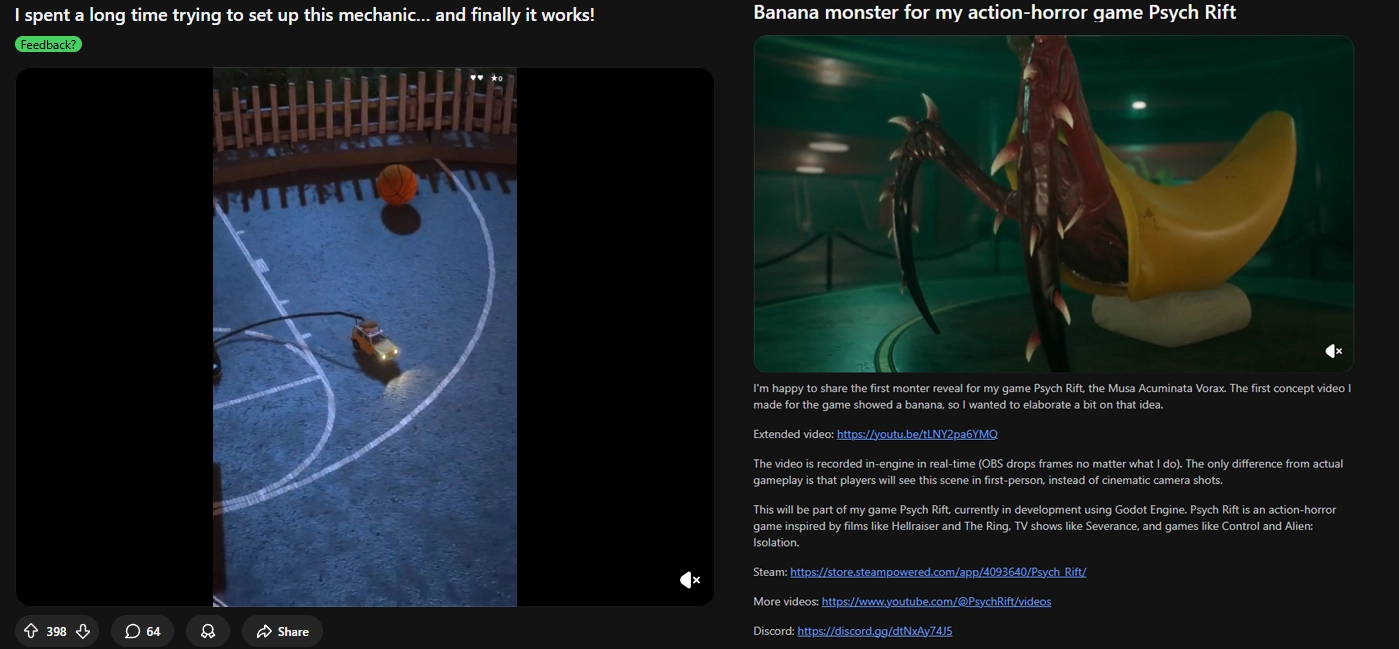
Milestone 2: The Feedback Loop
Closed Playtest
As soon as your build is stable enough to show the core fun (e.g., your main mechanics are working and the game doesn't crash), launch a Closed Playtest.
- Use the Steam Playtest feature to invite a small group of players
(such as friends, or Redditors and TikTokers who saw your post and commented that they liked it) - The In-Game Form: Embed a feedback form directly in the main menu.
- The Critical Questions: Don't just ask "Did you like it?" Ask for specific scores on:
- "How would you rate the movement/combat?"
- "How do the graphics feel compared to your favorite games?"
- "What other games in this genre do you play?"
- "How likely are you to recommend this to a friend?"
If your visuals score a 3/10 but your mechanics score a 9/10, you know exactly where to spend your budget.

Milestone 3: The Validation Cycle
Open Testing
Once you have implemented the feedback from the closed test, show the players you listened.
- The "I Heard You" Patch: Announce a major update to your playtesters. Show them the "Before vs. After" of the mechanics or visuals they critiqued.
- Building the Core: This creates a strong, invested community. When players see a developer actually changing the game based on their input, they become "Super-Fans."
- Validation: If your scores improve, you are ready to scale.
Milestone 4: The Public Demo
The Influencer Magnet
Now that your game is validated and polished, it’s time to open the gates. This isn't just a technical release, it’s a multiplier beat. You are taking the small, dedicated core you built in your playtests and using them to ignite a much larger audience
The Separate Demo Page
Steam has revolutionized how demos work. Previously, a demo was just a button on your main page, but now you have the option to create a dedicated store page for it. You absolutely should take advantage of this.
By having a separate page, your demo is treated like a "Free Game" by the algorithm. This gives you a unique chance to hit the Trending Free tab on the Steam front page, a spot usually reserved for full releases. This is free, massive exposure to users who specifically look for new experiences without a price tag.
The Review Shield
Separate demo pages allow players to leave User Reviews. This is your chance to build a positive shield before the main game even launches.
Every person who lands on your demo page is a potential lead, so use the developer message box at the top of the page to point them directly to the main game's wishlist button. Don't waste the opportunity to get your demo trending among "free apps" just because you didn't want to manage an extra page.
The Publisher Pitch
If your goal is to sign with a publisher, this is where you generate your most valuable proof of concept.
A pitch deck that simply says "players love our game" is weak, but a deck that includes a screenshot of 250 "Very Positive" Reviews on your demo page is undeniable. It proves that the market, not just your inner circle, is willing to play and praise your work.
Publishers look for that "Demo to Wishlist" conversion rate, if you can show that a high percentage of players who tried the demo ended up wishlisting the full game, you’ve made yourself a low-risk investment.
Influencer Outreach
The demo release is the starting gun for your creator outreach. Instead of just sending out keys randomly, you want to orchestrate a moment.
Reach out to your filtered list of influencers - the ones you identified as playing similar games at least one or two weeks before the demo goes public. Share the build with them upfront so they have time to record and edit.
Your goal is to have several videos or streams go live within the same 48-hour window as your demo launch. When a player sees multiple creators playing the same cool new demo, it creates an aura of "everyone is playing this."
Because the demo is free and has its own page, the barrier to entry is zero. A viewer clicks the link, hits "Download," and becomes part of your ecosystem instantly.
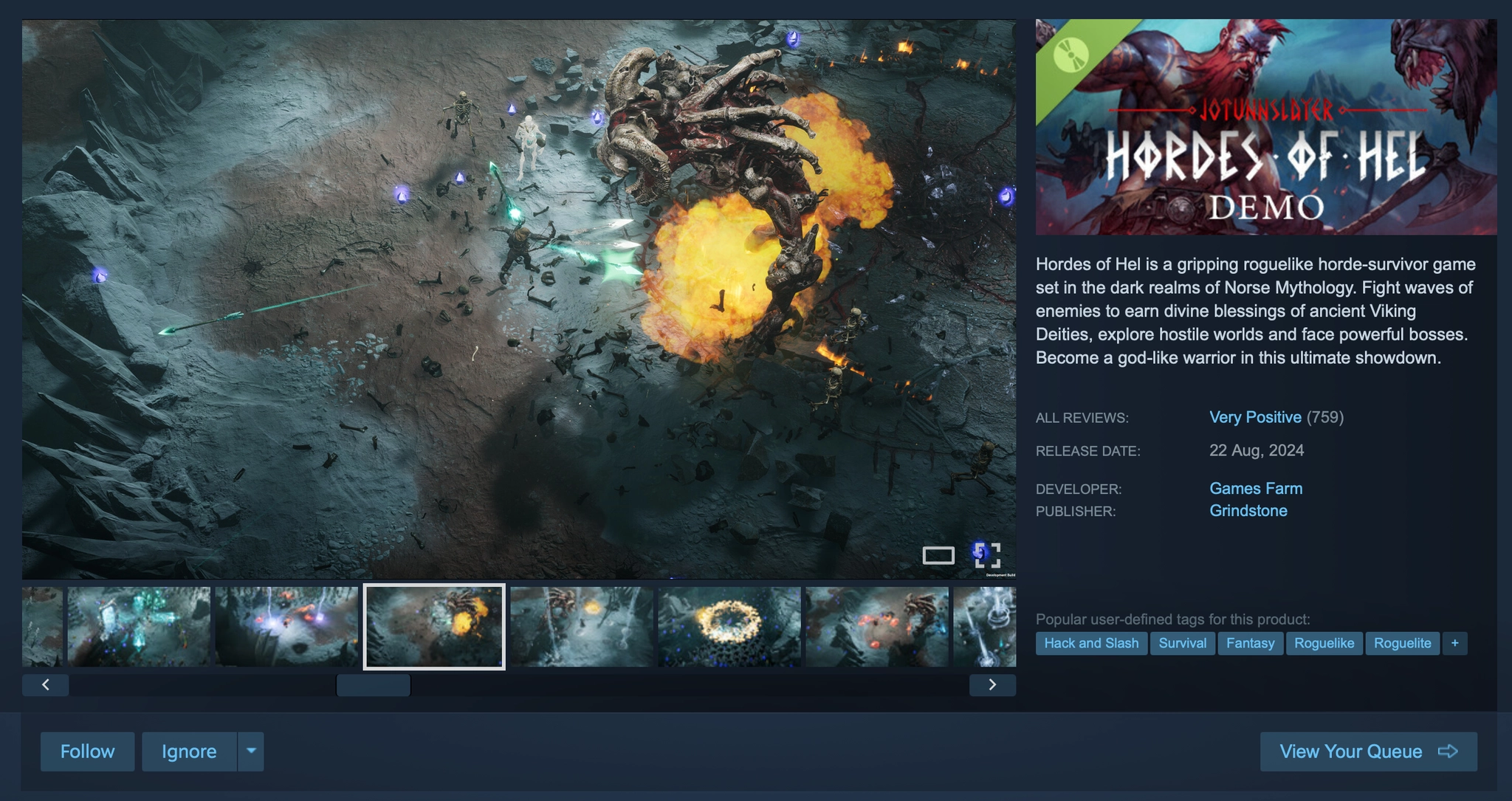
Milestone 5: Steam Next Fest
The Multiplier
This is your Grand Finale before launch. Treat it with extreme respect.
- The Warning: You only get one Next Fest per App. Do not waste it.
- The Publisher Deadline: Most publishers will not sign a game that has already completed its Next Fest. If you enter the event with 2,000 wishlists and leave with 2,600, you have effectively 'spent' your biggest marketing beat with low results. It’s very difficult to regain momentum or find a magic fix to grow your wishlist count once that peak visibility has passed.
- The Strategy: Enter Next Fest with as many wishlists as possible. It is a multiplier. If you enter with 20,000 wishlists, the algorithm will push you to the top of the "Most Wishlisted" lists, and you could walk away with 40,000.
- The Timing: Only attend when your demo is rock-solid and you have enough content to keep players engaged for 30-60 minutes.
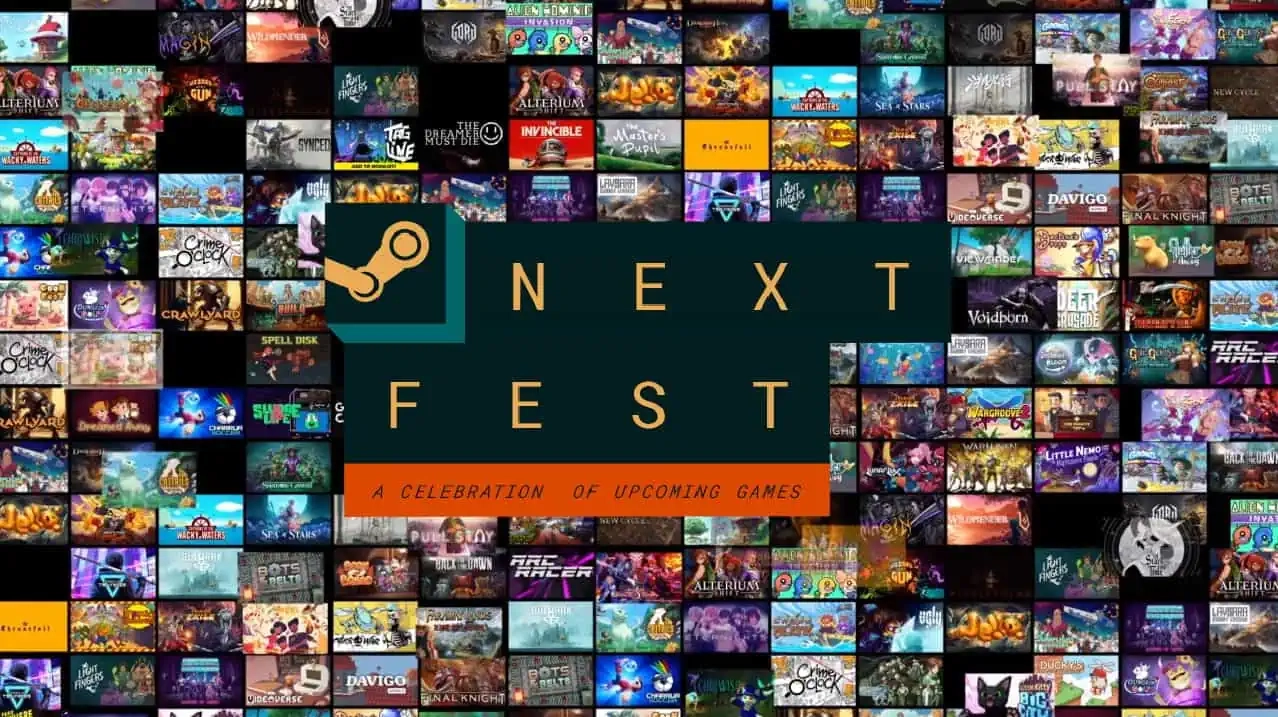
Milestone 6: The Release
The Final Peak
The release, whether into Early Access or a full 1.0, is the highest-stakes moment of your journey. While the previous milestones were about building the engine, this is the moment you open the throttle.
The "Oxygen Sucker" Check
In the modern market, it is impossible to find a launch day with zero competition. However, you must perform an "Oxygen Sucker" check to avoid being suffocated.
If a massive "Neighbor" game (a title in your exact genre) with 500k wishlists is launching on the same Tuesday you are with 50k, you are in the "Oxygen Zone." Players of that genre have limited time and money; when forced to choose, the title with 10x the visibility will often win the initial click.
If you see a genre giant moving into your release window, don't be afraid to shift your date by a week to find "clean air."
The Street Team Activation
This is the moment to call in every favor you’ve built in Discord and among your playtesters.
To trigger Steam’s "New & Trending" algorithm, you need a high-velocity surge of sales and reviews in the first 4 hours. Aim for your first 50 reviews as fast as possible.
A cluster of positive signals early on tells Steam that your game is converting. This is the signal that pushes you out of the depths and onto the front-page charts where organic traffic lives.
Collaborative Bundling
Don't launch in a vacuum. Reach out to the developers of your Neighbor games, the ones you’ve built relationships with and propose a "Complete the Set" Bundle.
Tell them your release date and offer to pin their bundle to the top of your Steam page during your launch week. Your launch-day traffic will boost their sales immediately.
In return, they can pin the bundle on their page later when they have a major update or sale. It is a long-term cross-pollination strategy that keeps your game visible to their audience long after your launch peak has faded.
Launch Stability and the "Review Pivot"
Your build must be rock-solid. A "Mixed" review score on Day 1 due to technical crashes is a death sentence.
However, if issues do arise and they often do, do not panic. Be ready to fix and patch in the first few hours.
If someone leaves a negative review because of a bug, fix it, push the patch, and reply to their review immediately.
Something like:
"So sorry about that! We just pushed a fix for this specific crash. Check out the latest build!"
Players are surprisingly forgiving when they see an active, caring developer. Many will change their "Negative" review to a "Positive" one simply because you listened and acted fast.
Final Warning
You cannot "save" a bad launch with marketing later. The Steam algorithm rewards momentum. If you launch with bugs and low velocity, the "New & Trending" window will close, and getting it back is 10x harder.
Spend the extra week on QA; a stable, boring launch is infinitely better than a "viral" one that crashes.
Case Studies & Data
1. Preserve
The "Cozy" Market Challenge
Preserve is a relaxing nature-building puzzle game developed by Bitmap Galaxy. On paper, it had everything: a 92% "Very Positive" rating, beautiful low-poly visuals, and a popular sub-genre (Nature/Cozy building). We worked on it from mid 2023, hitting Early Access in August 2024 and 1.0 in May 2025.
Despite its quality, marketing it taught us a vital lesson: Genre "Cliques" and the High Cost of Casual Visibility.
The Challenge: Penetrating the "Cozy" Bubble
One of the biggest surprises was realizing that the "Cozy Game" community is remarkably insular. The sub-genre is often dominated by a tight-knit group of creators, specific shows (like Wholesome Games), and developers who have already found success there.
The Barrier to Entry
If you aren't already part of this "inner circle," organic growth is capped. Unlike Action or Horror subreddits where a cool GIF can go viral instantly, cozy communities are smaller and reach a "saturation point" much faster.
The Ad Paradox
Because Preserve is easy to pick up and play, its potential audience is "everyone" (kids and adults alike). However, targeting "everyone" is incredibly expensive. We couldn't afford a $500K "brand awareness" campaign, so we had to be surgical.
What Failed: Mobile-First Ads (IG, FB, TikTok)
We experimented with Instagram and TikTok ads. The Cost Per Click (CPC) looked amazing, people were clicking! But the Conversion (compared to the price of a game) wasn’t good at all.
The Browser Friction
When a user clicks a Steam link on their phone, it opens in a mobile browser where they aren't logged in. They won't bother to find their password just to wishlist your game.
Conclusion
For a Steam-focused game, mobile social media ads are often a "vanity metric" unless you have a deep-linking solution that works perfectly.
What Worked: The "Personalized Connection" Strategy
We found our best results by manually engaging with a small group of high-impact influencers.
- The Human Touch: We didn't just send keys. We watched their streams. If an influencer made a joke or their chat mocked a specific "mistake" they made in-game, we took notice.
- Custom Content: In one instance, we created a custom 3D model in the game that referenced an influencer's specific "inside joke" and sent it back to them for their next beat. This created an authentic bond. Because they felt "part" of the development, they featured the game multiple times, far outperforming any paid ad.
The Hard Data (Preserve)
This is what an "Average-to-Strong" performance looks like in this genre
| Metric | Phase: Early Access (EA) | Phase: 1.0 Release |
| Launch Wishlists | 37,515 | (Cumulative) |
| First Week Sales | 7,257 (19.3% conversion) | 10,000+ |
| Refund Rate | 10% | 10% |
| Steam Rating | 85% (Very Positive) | 92% (Very Positive) |
Don't be fooled by "low CPC" on social media ads. If you are a small team with a limited budget, Manual Influencer Outreach, where you actually listen to their content and offer them something unique is 10x more valuable than a wide Instagram ad campaign. In the cozy genre, trust is the only currency that converts.
2. Jotunnslayer: Hordes of Hel
The Viral Snowball
If Preserve was a lesson in navigating a niche clique, Jotunnslayer: Hordes of Hel is a masterclass in leveraging Momentum, Disbelief, and the Feedback Loop. Started in early 2024, this survivor-like (Bullet Heaven) title took a crowded genre and injected it with high-fidelity 3D graphics and a grim Nordic soul.
This project proves that when you have a strong "Hook" and you listen to your players, the Steam algorithm doesn't just push you, it catapults you.
Phase 1: The "Mediocre to Great" Pivot
We didn't start with a masterpiece. We started with a prototype that friends rated a 6/10. Most devs would stop there or get defensive. We took the feedback, stripped the mechanics that weren't working, and iterated until the same group gave us an 8 o 9/10. We saved time by utilizing assets and code from a previous ARPG project.
Phase 2: The "Fake Game" Controversy
When we released the first trailer, something strange happened: People didn't believe it. Because the survivor-like genre is dominated by 2D or low-poly art, our high-fidelity 3D visuals looked "too good to be true."
- Turning Skepticism into Momentum: Users on Reddit and YouTube called it a "Diablo ripoff" or a "fake scam game." Instead of getting angry, we used this. We announced a Public Playtest immediately.
- The Result: Thousands signed up just to see if the game was real. Once they played it and saw it was legit, that skepticism turned into fierce advocacy.
Phase 3: The $5 Influencer Tactic
We were persistent. We built a massive list of genre-specific creators and hounded them—but we also used Guerilla Marketing.
- The Twitch "Door-Opener": For big streamers who ignore emails, we used $5 donations. We’d send a tip with a short message: "Hey, love the stream. We made a Nordic survivor-like that people think is fake, would love to see if you can break it.
- The ROI: Several major streamers played it purely out of curiosity from a $5 donation. This triggered the "Snowball Effect"—once one big creator plays, the media and other influencers follow suit.
Phase 4: Scaling via Separate Demo Pages
When Steam allowed separate store pages for Demos, we jumped on it.
- The Strategy: We treated the Demo launch like a mini-release. We added a new character specifically for the Demo to give existing playtesters a reason to come back.
- The Social Proof: The Demo page began collecting "Very Positive" reviews. When we eventually pitched for Next Fest and Early Access, we had a mountain of player sentiment to prove the game was a winner.
The Hard Data (Jotunnslayer)
This is what "Hyper-Growth" looks like when you hit the right genre with the right
| Metric | Phase: Early Access (EA) | Phase: 1.0 Release |
| Launch Wishlists | 180,000 | (Cumulative) |
| First Week Sales | 83,134 (50% conversion) | 10,000+ |
| Refund Rate | 10% | 10% |
| Steam Rating | 85% (Very Positive) | 92% (Very Positive) |
The Takeaway
A 50% conversion rate is unheard of in the modern market (the average is closer to 10–15%). This happened because we didn't just collect wishlists; we built a Community of Co-Authors.
By the time the game launched, 180,000 people felt like they helped build the game because we stayed in the "Feedback Loop" for over a year.
If people think your game looks "too good," don't be offended, be ready. Use their disbelief to drive them into a Playtest. Once a player goes from "This is a scam" to "This is my favorite new game," they become a fan for life.
Validation is the strongest marketing tool in your arsenal.
Helpful Tools
In the "Hard Way" journey, you don't have to build everything from scratch. There are specialized tools and communities that can give you the data and leverage you need to compete with bigger studios. Here are the ones that actually earn their keep.
Data & Market Intelligence
GameDiscoverCo: The gold standard for understanding how people find and buy games. Use it for sale predictions, wishlist-to-sales ratios, and deep-dive statistics. Their newsletter is mandatory reading for anyone serious about the business of games.
SteamDB: The ultimate "under the hood" look at the Steam ecosystem. It tracks concurrent players, historical price changes, and package updates. It’s essential for checking if your "Neighbors" are actually growing or fading.
VG Insights: A powerful tool for market research. It allows you to filter games by genre, tags, and release date to see estimated revenue and owner counts.
Marketing & Visibility
Robostreamer: Steam visibility thrives on "Live" broadcasts. Robostreamer allows you to host pre-recorded loops as a Live stream on your store page 24/7 without melting your own computer.
HowToMarketAGame: Run by Chris Zukowski, this site is a masterclass in Steam marketing. The blog and courses are great, but the Discord community is the real prize, it includes a constantly updated list of indie festivals and events you should be applying for.
Lurkit / Keymailer: These platforms connect developers with verified influencers. You can list your game here and let vetted creators request keys.
Community & Pitching
IndieGameBusiness: A massive community focused on the vital parts of games: contracts, taxes, and distribution. Their Discord is an excellent place to get feedback on your pitch deck before you send it to a real publisher.
Work with Indies: If you need to find specialized talent (like a trailer editor or a localization lead), this is the most curated and high-quality job board in the industry.
Thank You for Reading The Hard Way
Thank you so much for reading The Hard Way. Whether you read the entire wiki, or just jumped into a specific chapter to figure out some setting when you needed it most, I genuinely hope this resource saved you some time and a few bruises.
As I mentioned at the very beginning, this isn't a static textbook. The game industry changes at a breakneck pace, and I’ll be constantly updating these pages with new data, fresh case studies, and updated shortcuts as I continue my own journey in the trenches.
Because of that, this shouldn't be a one-time read. I want to keep the conversation going.
Let’s Connect
If you want to stay updated on new chapters or just see what I'm working on next, let's connect:
- LinkedIn: Where I share high-level publishing breakdowns and industry networking updates.
- Email: matej.hudak@grindstone.sk
- The Hard Way Discord: https://discord.gg/jMzwPrM4Mj
Supporting The Hard Way
This guide is entirely free and open to the indie community because I believe the best way to fix the industry is to share the knowledge.
With that said, if a specific chapter helped you avoid a costly mistake, saved you days of headaches in the Steamworks backend, or gave you the exact slide structure you needed to get your pitch signed, you can buy me a coffee to support the project!
Every bit of support helps keep these guides running, updated, and completely free of corporate fluff.